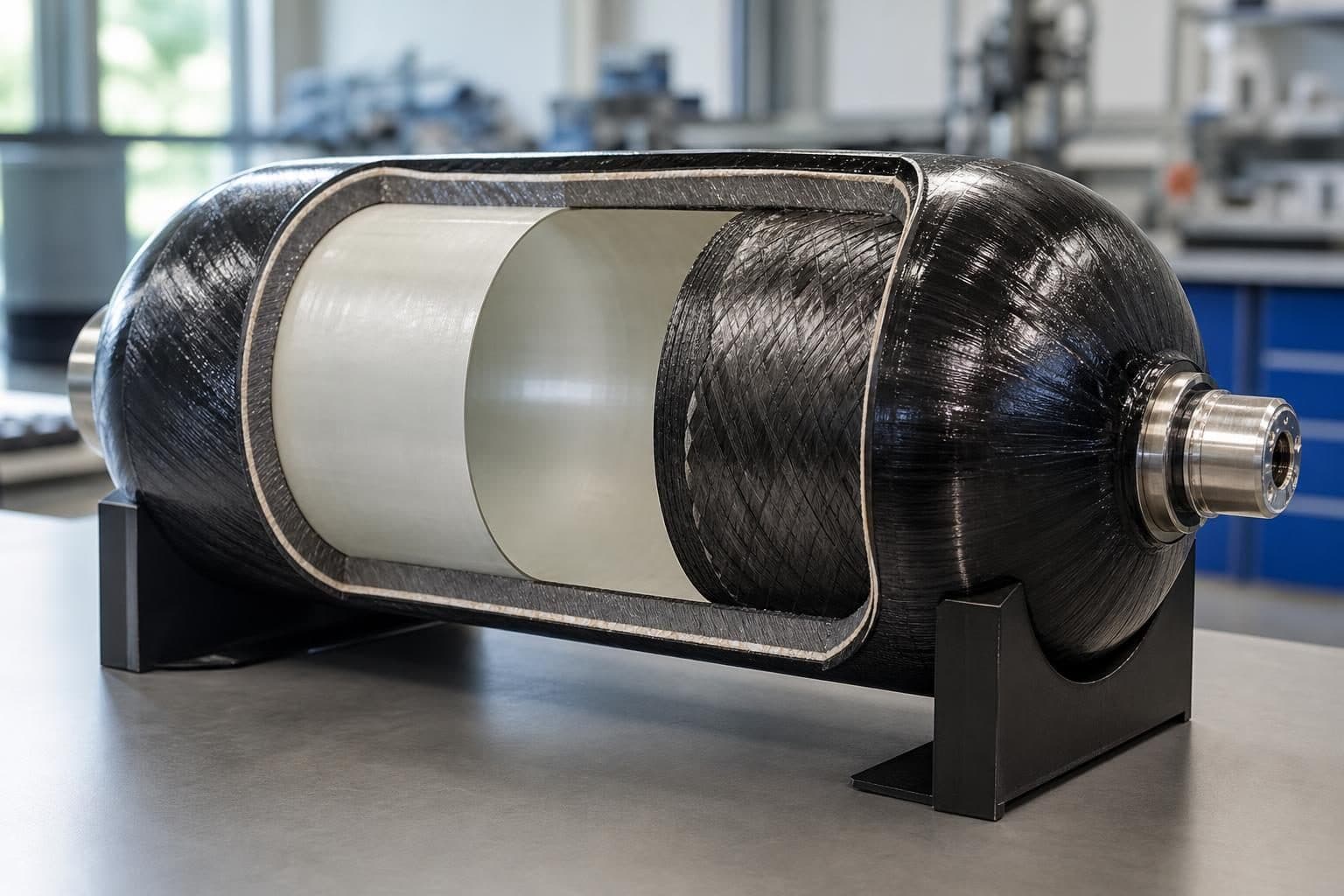
On a German Type 212 submarine running submerged on fuel cells, the hydrogen does not sit in a pressure tank. It is held in metal hydride cylinders mounted low in the hull, outside the pressure hull. Charging them in port releases heat and the cylinders have to be cooled; at sea, the hydrogen comes out only when the cylinders are warmed. That cycle of heat in and heat out is the defining feature of metal hydride storage.
How a metal hydride holds hydrogen
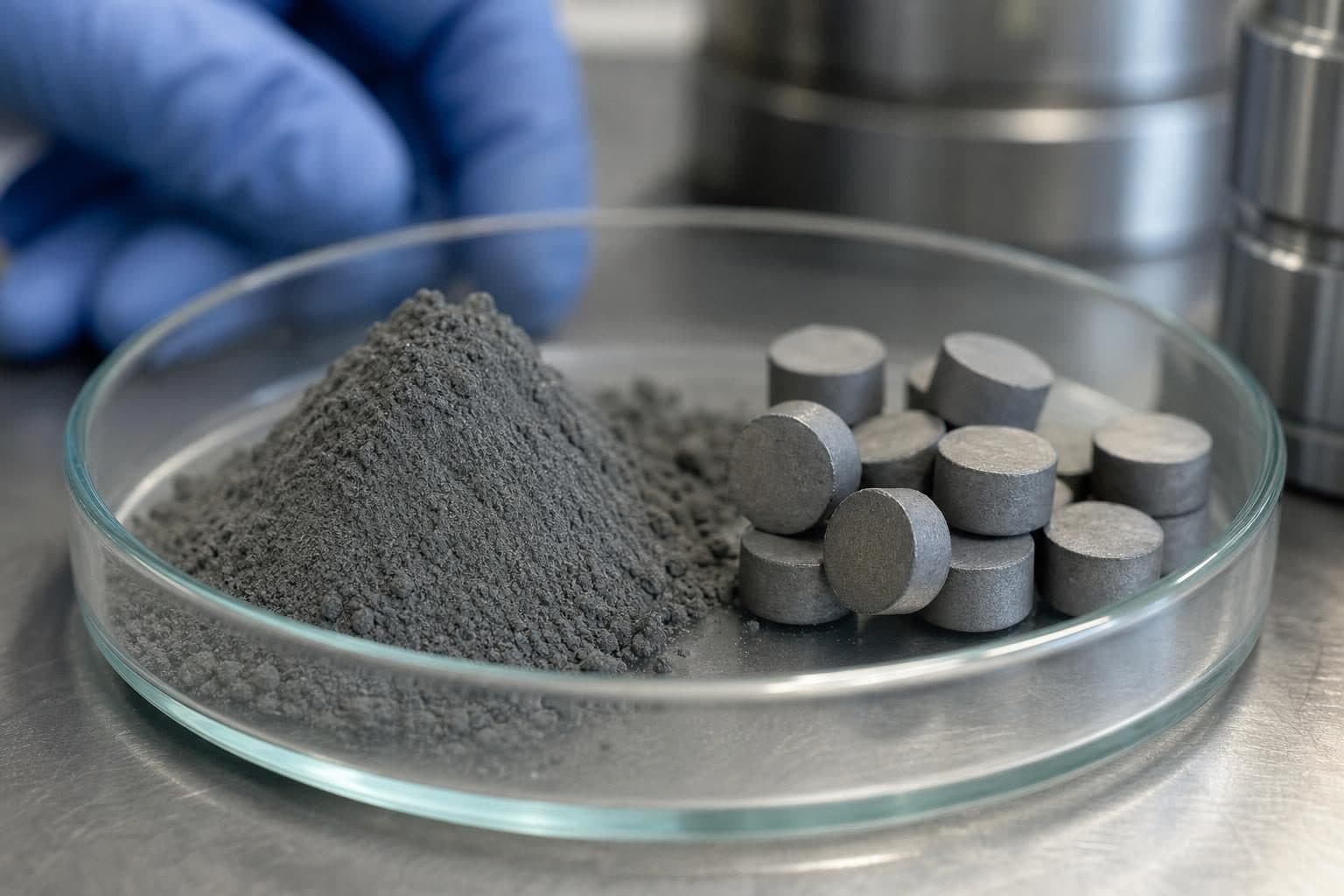
Certain metals and intermetallic compounds absorb hydrogen into their crystal lattice. A hydrogen molecule splits into atoms on the metal surface, the atoms diffuse inward and occupy gaps between metal atoms, and the material turns into a hydride. Reverse the conditions and the hydride gives the hydrogen back.
The behavior follows a plateau: at a given temperature, the hydride absorbs and releases hydrogen at a nearly constant pressure across most of its capacity. Raise the temperature and the plateau pressure rises. The van 't Hoff relation ties the two together through the reaction enthalpy, and that enthalpy decides whether a material is practical.
Three families illustrate the range.
| Material | Hydrogen by weight | Reaction enthalpy | Operating conditions |
|---|---|---|---|
| LaNi₅H₆ | about 1.4 % | about −30 kJ/mol H₂ | Plateau about 2–2.5 bar near room temperature |
| MgH₂ | 7.6 % | about −75 kJ/mol H₂ | Releases hydrogen at 1 bar only near 300 °C |
| NaAlH₄ (sodium alanate) | 5.6 % theoretical | between the two | Reversible with titanium catalysts, around 100–150 °C |
LaNi₅ is the textbook room-temperature hydride. It charges and discharges at a few bar, survives many cycles, and holds very little hydrogen per kilogram. Magnesium hydride holds five times as much but binds it so strongly that it needs around 300 °C to release it at atmospheric pressure. Alanates sit between them and became a research focus after it was shown in the late 1990s that titanium doping makes sodium alanate reversible at moderate temperatures.
Heat in, heat out
Absorption is exothermic and desorption endothermic, and the amounts are large. A worked example: one kilogram of hydrogen is about 496 moles. In LaNi₅, at roughly 30 kJ per mole, absorbing that kilogram releases about 15 MJ, or 4.1 kWh. That is about 12 % of the hydrogen's lower heating value of 33.3 kWh/kg. In magnesium hydride, at roughly 75 kJ per mole, it is about 37 MJ, close to a third of the hydrogen's energy.
The heat has to go somewhere during filling and come from somewhere during use. A fast fill of a hydride tank is a heat-exchanger problem, not a pressure problem; without enough cooling the tank warms, the plateau pressure climbs to meet the supply pressure, and absorption stalls. On the discharge side, the low-temperature hydrides can use waste heat from a fuel cell running at 60–80 °C. Magnesium hydride needs a heat source at about 300 °C, which in a vehicle means burning part of the fuel.
The weight penalty
The host metal never leaves the tank. Storing 5 kg of hydrogen, about what a passenger fuel cell car carries, in LaNi₅ at 1.4 % takes roughly 360 kg of alloy powder, before the vessel, heat-exchanger tubes and fittings are added. A complete LaNi₅ system lands well below 1 % hydrogen by weight. The DOE's 2025 onboard target of 5.5 % for the whole system is out of reach for room-temperature hydrides and demanding even for magnesium.
By volume, the same materials look much better. The hydrogen packed into the lattice of many hydrides reaches densities above that of liquid hydrogen, so a hydride canister is compact for its contents. That combination of high volumetric and low gravimetric density defines where hydrides are used.
Where metal hydrides are used
Submarines are the best-known case. The Type 212 and its export relatives combine hydride storage for hydrogen with liquid oxygen, feeding PEM fuel cells for long, quiet submerged runs. The weight is ballast anyway, and low-pressure storage inside a hull is preferable to high-pressure gas.
Forklifts are the industrial version of the same logic. A forklift needs a heavy counterweight, so a few hundred kilograms of hydride in place of cast iron is a small penalty, and some fuel cell forklift programs have used hydride storage for that reason. Most fuel cell forklifts in North American warehouses now use 350 bar compressed gas, which refuels faster.
Stationary storage is the third niche: hydride banks that buffer electrolyzer output for buildings or remote sites, where weight is irrelevant and low pressure simplifies permitting. Hydrides also work as thermal compressors, raising hydrogen pressure with heat instead of moving parts, and as purifiers, since many hydrides absorb hydrogen selectively and reject other gases.
MOFs and porous adsorbents
Adsorbents store hydrogen in a different way. Nothing reacts. Hydrogen molecules stay intact and cling to the internal surface of a porous solid through weak van der Waals forces, forming a layer denser than the free gas. The more surface per gram, the more hydrogen.
Metal-organic frameworks are the materials that pushed this idea furthest. They are crystalline solids built from metal clusters connected by organic linkers, with internal surface areas of several thousand square meters per gram. MOF-5, a zinc oxide cluster joined by terephthalate linkers, is the benchmark. A 2007 study by Kaye, Dailly, Yaghi and Long showed that carefully prepared MOF-5 reaches 7.1 % excess hydrogen uptake by weight at 77 K and 40 bar, and a calculated total uptake of 10 % by weight at 100 bar, equivalent to about 66 grams per liter. Badly handled samples reached only 5.0 %, because MOF-5 gradually decomposes in humid air.
Two terms matter when reading such numbers. Excess uptake counts only the hydrogen held beyond what the empty pore volume would contain as free gas. Total uptake adds the gas in the pores, and that is what a tank designer cares about. Usable capacity is lower again, since some hydrogen remains adsorbed at the tank's minimum delivery pressure.
Why cryogenic
The binding energy of hydrogen on a typical MOF surface is a few kilojoules per mole. At room temperature, thermal motion overwhelms it, and uptake falls to around 1 % by weight or less. At 77 K, the boiling point of liquid nitrogen, the surface holds on. A MOF tank for hydrogen is therefore a cryogenic tank, needing insulation and either liquid nitrogen cooling or a cold fill, which removes much of its advantage over cryo-compressed gas.
Research has looked for frameworks with stronger binding sites, such as exposed metal cations, aiming for an adsorption enthalpy of roughly 15–20 kJ/mol that would allow useful storage near room temperature. Such materials exist in small samples. None has reached a practical tank.
The natural gas connection
Methane is a much easier guest. The larger molecule interacts more strongly with carbon and MOF surfaces, and useful uptake happens at room temperature and moderate pressure. That is the basis of adsorbed natural gas, which fills tanks at about 35–50 bar instead of the 200–250 bar of CNG. The research on MOFs for hydrogen and for methane runs in parallel, often in the same laboratories and with the same frameworks, and the U.S. Department of Energy has funded both under separate programs.
Current research limits
The open problems are the same in most reviews. For hydrides: kinetics (how fast the material absorbs and releases), cycle stability over thousands of fills, heat management in large beds, and the cost and supply of rare-earth or catalyst elements. For adsorbents: the cryogenic requirement, packing powders into dense monoliths without losing surface, and stability against moisture. For both: system-level weight. A material that meets a target in a sample cell loses a large share of its advantage once the vessel, heat exchangers and controls are counted.
Higher capacities exist on paper. Complex hydrides built on boron, such as composites of lithium borohydride and magnesium hydride, reach about 11 % hydrogen by weight, and ammonia borane about 12 %. The first group needs high temperatures and releases hydrogen slowly; the second gives up its hydrogen irreversibly, so the spent material must be regenerated in a chemical plant, not refilled at a pump. Each gain in capacity so far has come with a harder release step.
The DOE groups both families under materials-based storage, next to chemical hydrides and liquid carriers, and compares them against the onboard targets on its storage program pages. How they stack up against compressed and liquid hydrogen is laid out in the hydrogen storage overview, and the methane side in natural gas storage. The best room-temperature hydride still carries less hydrogen per kilogram of system than a 700 bar tank at its end of life.