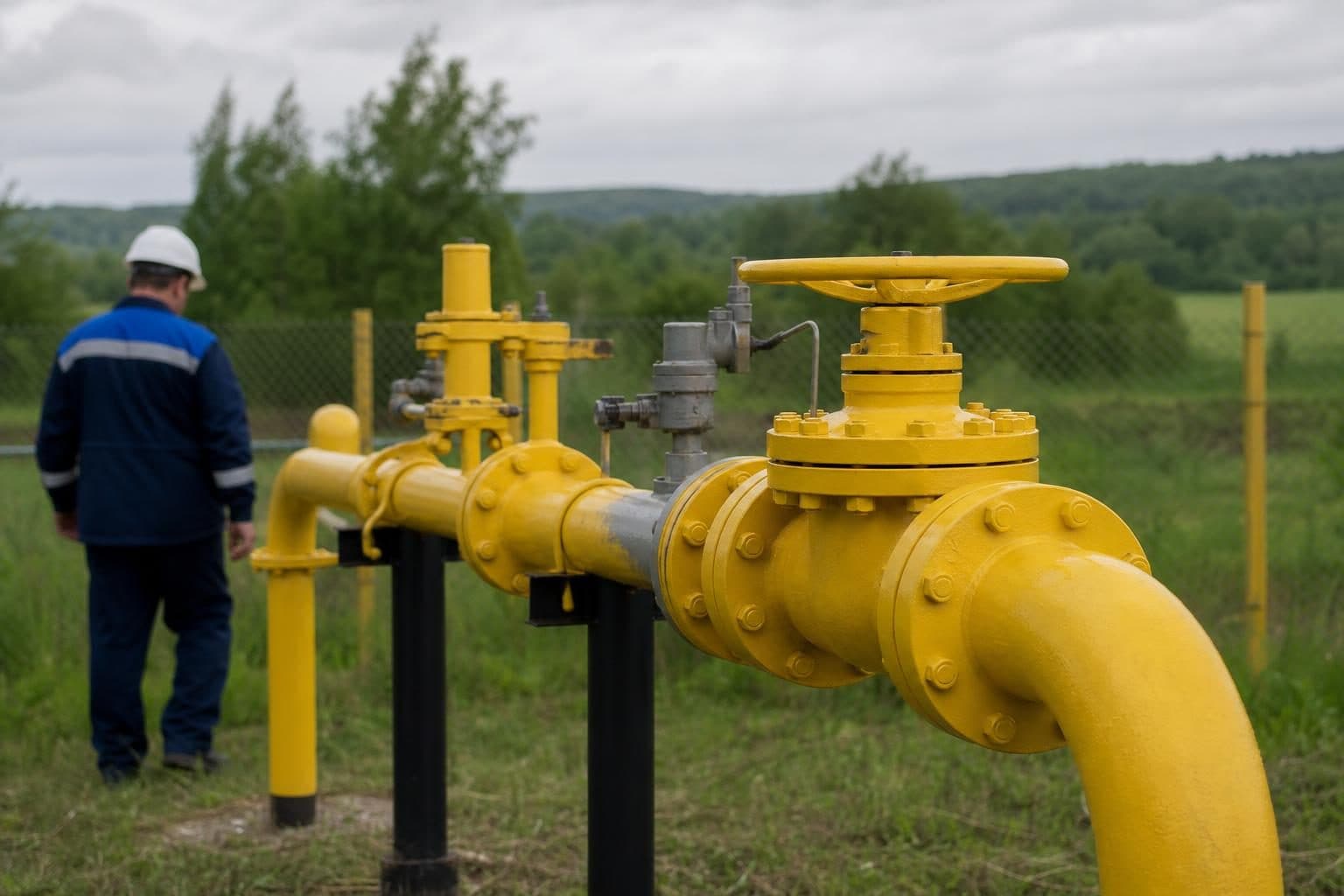
Between August 2021 and June 2022, 668 houses, a primary school, a church and several small businesses in Winlaton, near Gateshead in the north of England, cooked and heated with gas that was one fifth hydrogen by volume. Northern Gas Networks ran the trial as the second phase of the HyDeploy program. Residents did not change their boilers or hobs, and the network showed no increase in component failures against its own record on natural gas.
That result is the strongest argument for hydrogen blending: an existing gas grid can carry a meaningful share of hydrogen without anyone replacing appliances. The arithmetic of energy content is the strongest argument against it.
What "20 percent" means in energy
Gas is blended and regulated by volume, but customers buy energy. On a higher heating value basis, a normal cubic meter of methane carries about 39.8 MJ and a normal cubic meter of hydrogen about 12.7 MJ.
A worked example for a 20 % blend:
| Blend (by volume) | Energy per m³ (HHV) | Change vs methane | Hydrogen share of energy |
|---|---|---|---|
| 0 % H₂ | 39.8 MJ | — | 0 % |
| 5 % H₂ | 38.4 MJ | −3.4 % | 1.7 % |
| 10 % H₂ | 37.1 MJ | −6.8 % | 3.4 % |
| 20 % H₂ | 34.4 MJ | −13.6 % | 7.4 % |
| 30 % H₂ | 31.7 MJ | −20.4 % | 12.0 % |
A 20 % blend displaces roughly 7 % of the methane by energy, and the carbon dioxide from combustion falls by about the same 7 %. To deliver the same heat, customers draw about 16 % more gas by volume, so meters spin faster and bills have to follow measured energy content.
At the burner, the effect is smaller than the heating value drop. The Wobbe index, heating value divided by the square root of relative density, governs heat input through a fixed orifice. Pure methane sits at about 53.5 MJ/m³. The 20 % blend is lighter, which lets more of it through the same jet, and its Wobbe index comes out near 51 MJ/m³, about 5 % lower. Appliances built for natural gas already cope with swings of that order between gas sources, which is the technical reason moderate blends work without adjustment.
A household example makes the scale concrete. A home that uses 1,200 cubic meters of natural gas a year would draw about 1,390 cubic meters of a 20 % blend for the same heat. About 280 of those cubic meters would be hydrogen, roughly 25 kg, carrying the energy of some 90 cubic meters of methane.
Injection and mixing
Hydrogen enters the grid at an injection skid: a metering unit that measures both streams, a control valve that holds the blend ratio as the network's flow changes through the day, and a mixer and analyzer downstream to confirm that the gas leaving the site is within limits. The ratio has to hold while household demand rises and falls through the day. The difficult part is low demand. On a summer night the gas flow through a local network falls sharply, and a fixed hydrogen supply would push the blend above its limit unless the injection rate falls with it.
Typical limits
There is no single limit. A review of technical and regulatory limits by Erdener and colleagues, published in the International Journal of Hydrogen Energy in 2023, sets out national limits that differ widely from country to country, many of them written when networks were expected to carry natural gas only, and it treats transmission and distribution separately because their equipment tolerates hydrogen differently.
The 2013 NREL review by Melaina, Antonia and Penev remains the reference most often quoted in the United States. Its conclusion: at relatively low concentrations, less than 5–15 % hydrogen by volume, blending appears viable without significantly increasing risks to end users, the distribution network or public safety. The authors stressed that the right level varies between pipeline systems and gas compositions and must be assessed case by case.
In Great Britain, the government published a strategic policy decision on 14 December 2023 to support blending of up to 20 % hydrogen by volume into gas distribution networks, if enabled once the safety evidence has been reviewed. In July 2025 a separate consultation opened on blending into the national transmission network. In Germany, the 2021 revision of the DVGW G 260 gas quality rules added a gas family for hydrogen and no longer excludes higher blends in principle, while European gas quality rules and the needs of industrial customers keep practical levels low in many parts of the network.
If a utility plans to inject hydrogen, the binding limit is usually not the pipe. It is the most sensitive customer downstream.
Appliances, engines and turbines
Domestic appliances are the best documented. At Keele University, the first HyDeploy phase ran from October 2019 for 18 months on a private network serving 100 homes and 30 university buildings, at up to 20 % hydrogen. It found no adverse interaction with pipes, boilers, hobs, cookers or meters. Winlaton then repeated the test on a public network with a different set of customers and reported the same outcome. A third phase moved to industry, with Pilkington blending up to 20 % hydrogen into float glass production and Unilever into consumer goods manufacturing.
Gas turbines are tolerant within limits set by the combustor. In March 2022, the 485 MW Long Ridge combined-cycle plant in Hannibal, Ohio injected a 5 % hydrogen blend into its GE 7HA.02 turbine, the first time a utility-scale GE gas turbine burned hydrogen in a commercially operating power plant. The hydrogen was a by-product from a neighboring industrial facility. The turbine is rated for about 15–20 % hydrogen by volume initially, and higher fractions require combustor changes because of flashback risk.
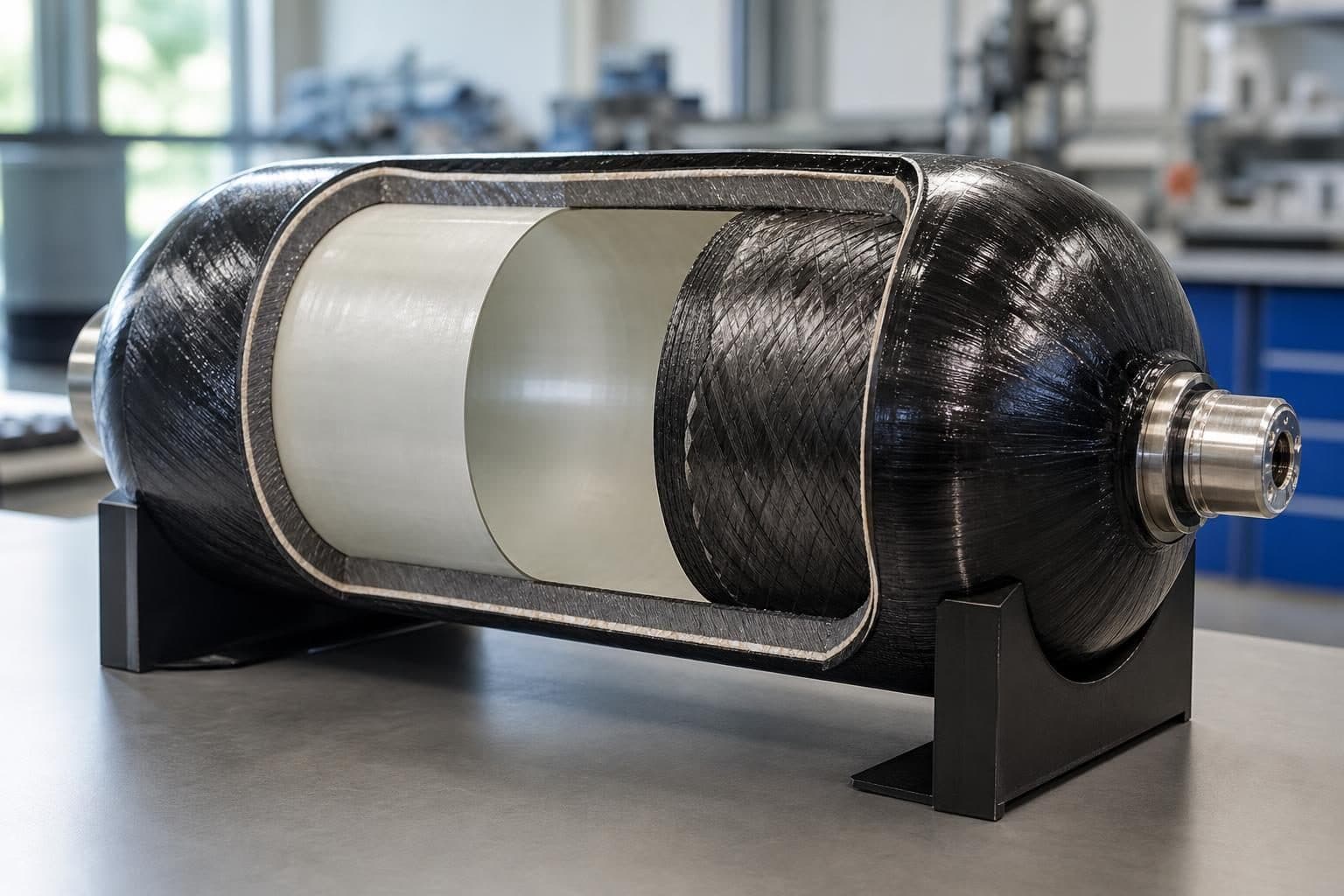
Some users cannot accept even small amounts. Natural gas vehicles with steel cylinders, some industrial processes that use gas as a chemical feedstock, and equipment calibrated tightly to gas composition, such as certain glass and ceramics burners, need either a cap at their connection or protection from blended gas. Underground storage in porous rock raises separate questions about hydrogen reacting with microbes and minerals. The page on CNG vs LNG covers how vehicle fuel systems are specified, and natural gas vehicles the tank types involved.
Embrittlement in pipelines
Pipelines are where materials matter most. Modern distribution networks in Britain and many other countries use polyethylene for low-pressure mains and service lines, and polyethylene is largely unaffected by hydrogen. Older cast iron mains have their own leakage problems regardless of the gas.
Transmission pipelines are steel, operated at high pressure. Hydrogen atoms diffuse into high-strength steels and weld zones and reduce fracture toughness and fatigue life, an effect that grows with hydrogen partial pressure. A 20 % blend at 70 bar exposes the steel to a hydrogen partial pressure of 14 bar, enough to matter for fatigue in cyclically loaded lines. Operators assess pipe grade, weld quality, defect sizes and pressure cycling before raising the blend, and sometimes lower the operating pressure. Dedicated hydrogen pipelines in the United States, about 1,600 miles of them, are built to ASME B31.12 with steels and stress levels chosen for hydrogen service.
Compressors are the other weak point. Centrifugal machines designed for natural gas lose head with a lighter gas, so a transmission line carrying a high blend moves less energy per unit of compressor power.
Deblending
Where a customer needs pure hydrogen, or must be shielded from it, the hydrogen can be pulled back out. The options are membranes, which let hydrogen pass faster than methane; pressure swing adsorption, the workhorse of refinery hydrogen purification; and electrochemical separation, which pumps hydrogen across a proton-conducting membrane. Recovering hydrogen from a low-concentration blend takes energy and capital, and purity for fuel cell vehicles under SAE J2719 is demanding. Deblending is therefore discussed mostly at specific points, such as a hydrogen station fed from a blended main or an industrial user that cannot accept hydrogen.
The broader question of whether blending is worth doing at all is mostly about its purpose. The UK's 2023 decision ties its support to blending's strategic role, and the 2025 transmission consultation presents blending chiefly as a reserve outlet for early hydrogen producers, an offtaker of last resort, more than as a way to decarbonize the gas supply. For a full comparison of the two gases, see hydrogen vs natural gas; for keeping pure hydrogen, the hydrogen storage guide.
Hawaiʻi Gas, which makes synthetic natural gas on Oʻahu, blends up to 15 % hydrogen into it and is described as the only US utility doing so at that level. In 2024 it announced partners for projects intended to lift the hydrogen share of its fuel mix to up to 20 %.