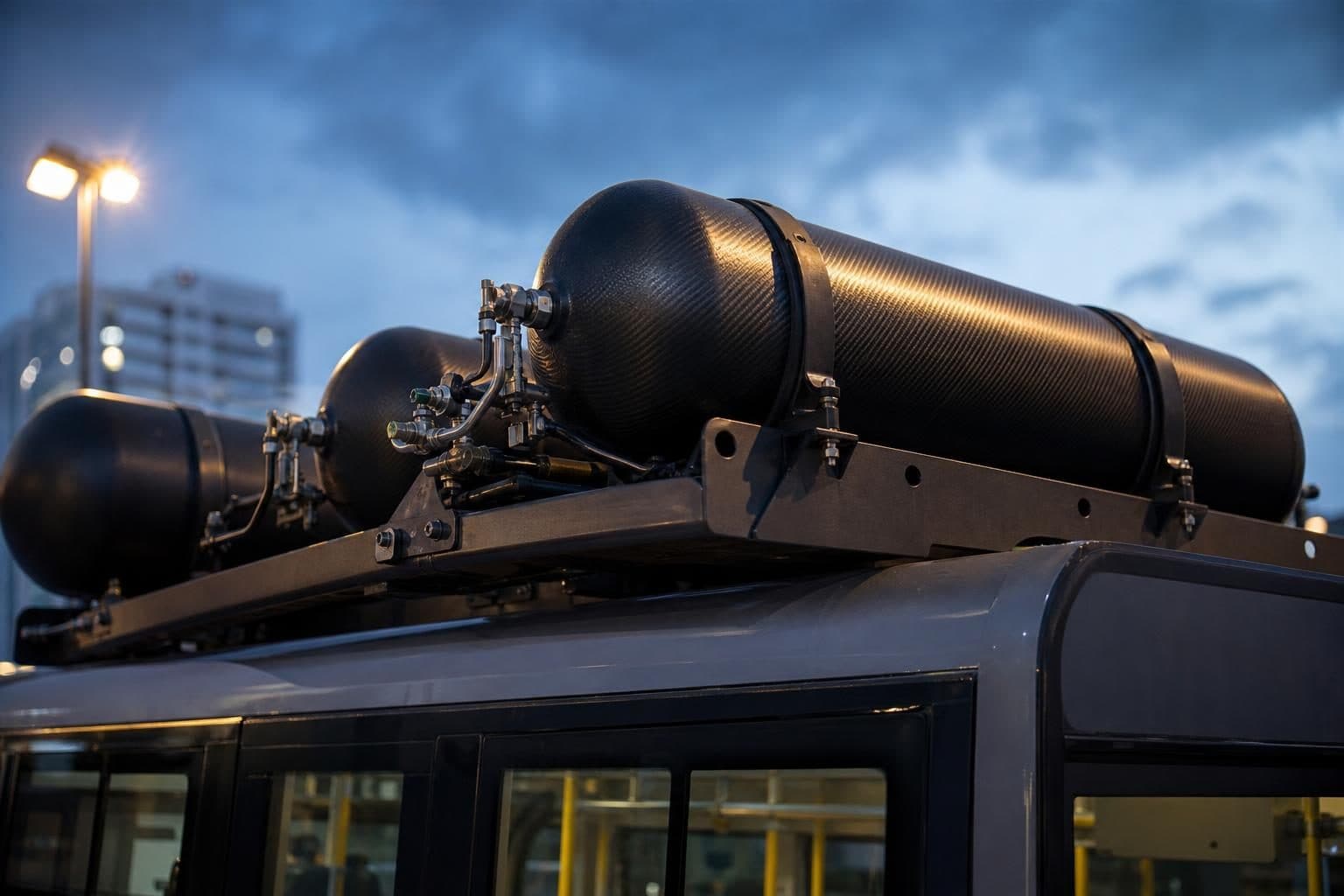
A tractor-trailer leaving a distribution center at 6 a.m. with 600 miles ahead of it needs roughly 100 diesel gallons of fuel on board. If that fuel is natural gas, the fleet has two ways to carry it. Compress it into cylinders behind the cab at 250 bar, or cool it into a liquid at −162 °C and carry it in an insulated tank on the frame rail. Same molecule, same engine family, two very different trucks.
Compression versus liquefaction
Compressed natural gas (CNG) is pipeline gas pushed by a multi-stage compressor into cylinders at 200–250 bar. In the United States the standard vehicle pressure is 3,600 psi, about 248 bar. Nothing about the gas changes except its density.
Liquefied natural gas (LNG) is natural gas cooled below its boiling point, about −162 °C (−260 °F) at atmospheric pressure. Before cooling, the gas is cleaned of carbon dioxide, water and heavier hydrocarbons that would freeze. The liquid occupies roughly 1/600 of the volume of the gas at room temperature and atmospheric pressure. Liquefaction happens at a plant, either a large export terminal or a small-scale unit, and the LNG then travels by cryogenic tanker to the fueling station.
The two methods move the difficulty to different places. CNG puts it in the tank, which has to hold very high pressure. LNG puts it in the supply chain, which has to keep the fuel cold from the plant to the engine.
Energy density in numbers
Natural gas at 250 bar and 15 °C weighs about 199 kg per cubic meter. At a lower heating value of 20,160 Btu per pound, about 46.9 MJ/kg, that is roughly 9.3 MJ per liter of tank. Liquid methane at its boiling point weighs about 422 kg per cubic meter, and with LNG's heating value of 21,240 Btu per pound (49.4 MJ/kg) it carries about 21 MJ per liter. Diesel, at 128,488 Btu per gallon, holds about 35.8 MJ per liter.
| Fuel | Storage condition | Density | Energy per liter (LHV) | Per gasoline gallon equivalent |
|---|---|---|---|---|
| CNG | 250 bar, 15 °C | ≈199 kg/m³ | ≈9.3 MJ/L | 5.66 lb (2.57 kg) |
| LNG | ≈1 bar, −162 °C | ≈422 kg/m³ | ≈21 MJ/L | ≈1.5 gal of liquid |
| Diesel | ambient | ≈835 kg/m³ | ≈35.8 MJ/L | n/a |
Run the numbers for that 600-mile truck. One diesel gallon equivalent works out to about 6.37 lb (2.89 kg) of CNG and about 6.05 lb (2.74 kg) of LNG, using the heating values above. A day's 100 DGE means about 289 kg of CNG or 274 kg of LNG.
At 199 kg/m³, the CNG load needs about 1,450 liters of cylinder water volume. In Type IV composite tanks at roughly 0.3–0.45 kg per liter, the cylinders alone weigh 435–650 kg before mounting hardware. The LNG load fills about 650 liters of liquid, plus vapor space and insulation, and fits in one or two saddle tanks. LNG stores the same day's energy in less than half the volume, and the difference shows up as cab space, axle weight and payload.
The tank volume needed for any fuel load can be checked with the tank capacity calculator, and the fuel comparison tool puts these energy figures next to gasoline, propane and hydrogen.
Infrastructure
A CNG station needs a gas main, a compressor and storage. Where a utility line runs close enough, the gas arrives continuously and the station's main costs are the compressor, the high-pressure storage cascade and electricity. Fast-fill stations store compressed gas, often at about 4,300 psi, to fill vehicles in minutes. Time-fill stations, common at fleet depots, fill vehicles directly from the compressor overnight and need very little storage.
An LNG station needs no pipeline connection. It needs a vacuum-insulated storage tank, a cryogenic pump and a reliable supply of liquid delivered by tanker, often from a plant hundreds of kilometers away. That makes LNG practical in places the gas grid does not reach, and it makes the station dependent on a logistics chain the operator does not control. Some stations combine the two: LCNG sites store LNG and vaporize and compress it to serve CNG vehicles as well.
The AFDC notes that liquid's higher density is the reason LNG suits longer-range trucks, and that holds at the station level too. One LNG delivery refills many trucks without a compressor running for hours.
Which vehicles and duty cycles
CNG dominates light-duty vehicles, taxis, buses and refuse trucks. These vehicles run fixed routes, return to base and can carry cylinders on the roof or behind the cab. Transit agencies in particular have built large CNG fleets around depot time-fill stations. If a fleet refuels overnight at its own yard and its daily mileage fits within one tank, CNG is usually the easier choice.
LNG fits high-mileage heavy trucks on corridors with LNG stations, and ships, where the volume of fuel makes compression impractical. Mining haul trucks and locomotives have run LNG trials for the same reason. The LNG trucking guide covers the road side in more detail.
A middle option sits between the two: very large CNG packs of Type IV cylinders mounted behind the cab of a heavy truck. They give up some range against LNG but avoid the cryogenic supply chain and boil-off entirely.
Cost drivers
The gas itself is the same commodity, so price differences come from what is done to it.
For CNG, the costs sit in the compressor and its electricity, station storage, and above all the vehicle cylinders. Composite Type III and IV tanks cost roughly three and a half times as much per liter as steel, and a heavy truck may need well over a thousand liters of them. Tanks also expire after their certified life, typically 15 to 20 years, and must be replaced.
For LNG, the costs sit upstream: liquefaction plants use a large amount of energy to reach −162 °C, and the fuel then needs cryogenic trucking and storage. Vehicle LNG tanks are expensive too, and a small vehicle's tank costs nearly as much as a large one's, which is one reason LNG has never made sense for cars.
Handling and safety
The hazards differ as much as the hardware. A CNG system stores a lot of mechanical energy, so its safety rests on cylinder design, burst margins, regular inspection and pressure relief devices that vent the tank in a fire. Leaked gas at ambient temperature is lighter than air and rises away from the vehicle.
LNG adds cold. A splash of liquid at −162 °C causes cryogenic burns, and ordinary carbon steel becomes brittle at that temperature, so piping and tanks use stainless steel or aluminum alloys. Cold vapor from a spill is denser than the surrounding air until it warms up, so it can drift along the ground for a while before it starts to rise. Drivers who refuel LNG trucks wear face shields and gloves, a step CNG drivers do not need. Fueling also differs in feel: a CNG nozzle locks onto a receptacle and the dispenser stops at the settled pressure, while an LNG fill involves venting or returning vapor from the vehicle tank.
Life-cycle emissions and renewable supply
At the engine, the two fuels burn the same methane, so the carbon dioxide per unit of energy is identical. Differences come from the chain around them. Compression to 250 bar uses electricity at the station. Liquefaction uses a much larger amount of energy at the plant, and cryogenic trucking adds diesel miles. LNG also carries the risk of methane escaping through boil-off venting, a loss that matters because methane traps far more heat than carbon dioxide over the first decades after release.
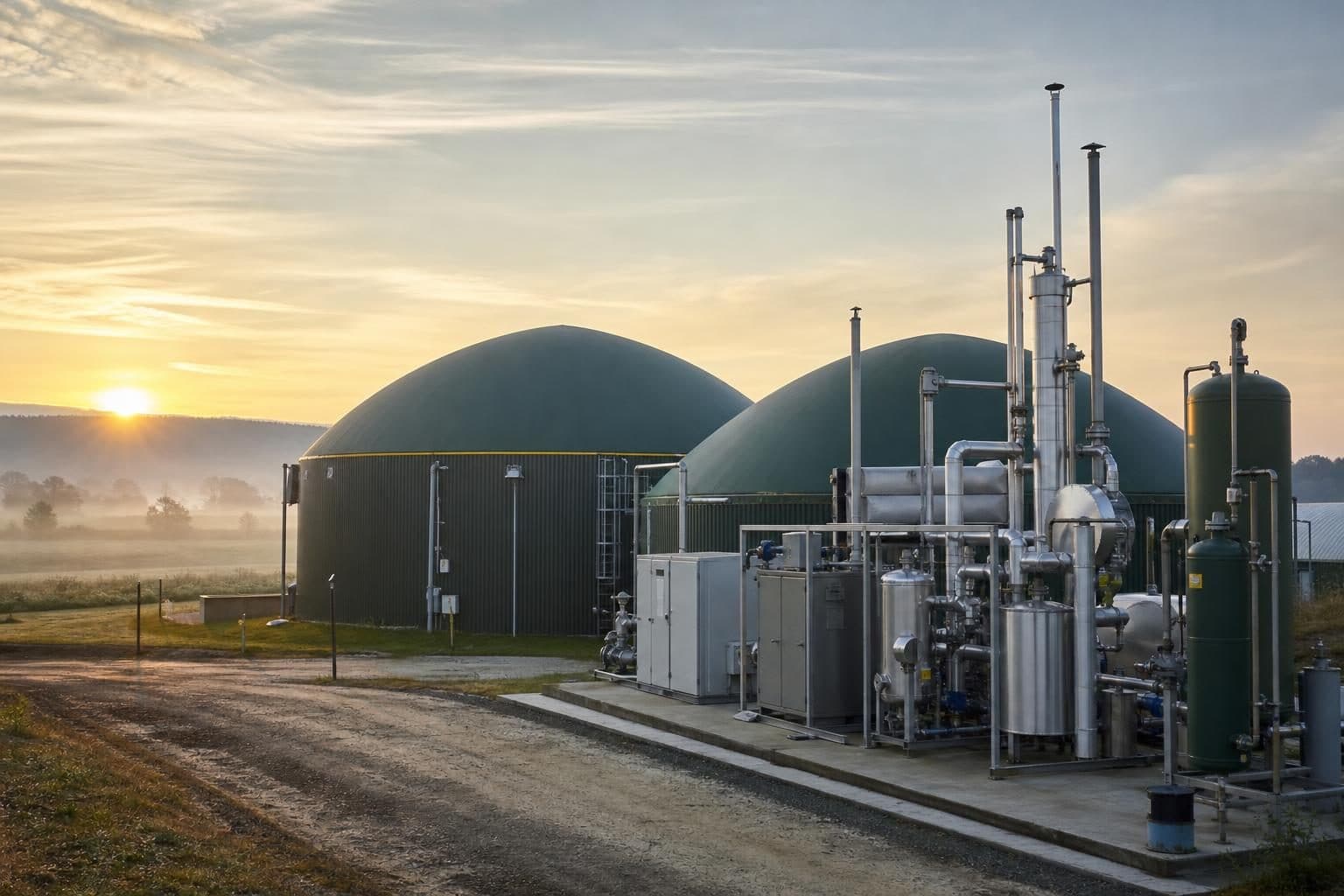
Either fuel can be made from biomethane instead of fossil gas. Once biogas from a landfill or digester is upgraded to pipeline quality, it can be compressed or liquefied in exactly the same equipment, and the renewable natural gas guide explains how that changes a fleet's carbon accounting. For a broader look at the fuel itself, including methane leakage, see is natural gas clean.
Boil-off and the parked truck
Boil-off is the cost CNG does not have. Heat leaks into every cryogenic tank, part of the liquid evaporates, and the pressure rises. On a truck that runs daily, the engine consumes the vapor and nothing is lost. On a truck parked over a long weekend, the pressure climbs until the relief valve opens and vents methane, a strong greenhouse gas, to the atmosphere. The time a full tank can sit before that happens is its hold time, and fleets that plan LNG operations schedule around it. A CNG truck can sit in a yard for a month and lose nothing.