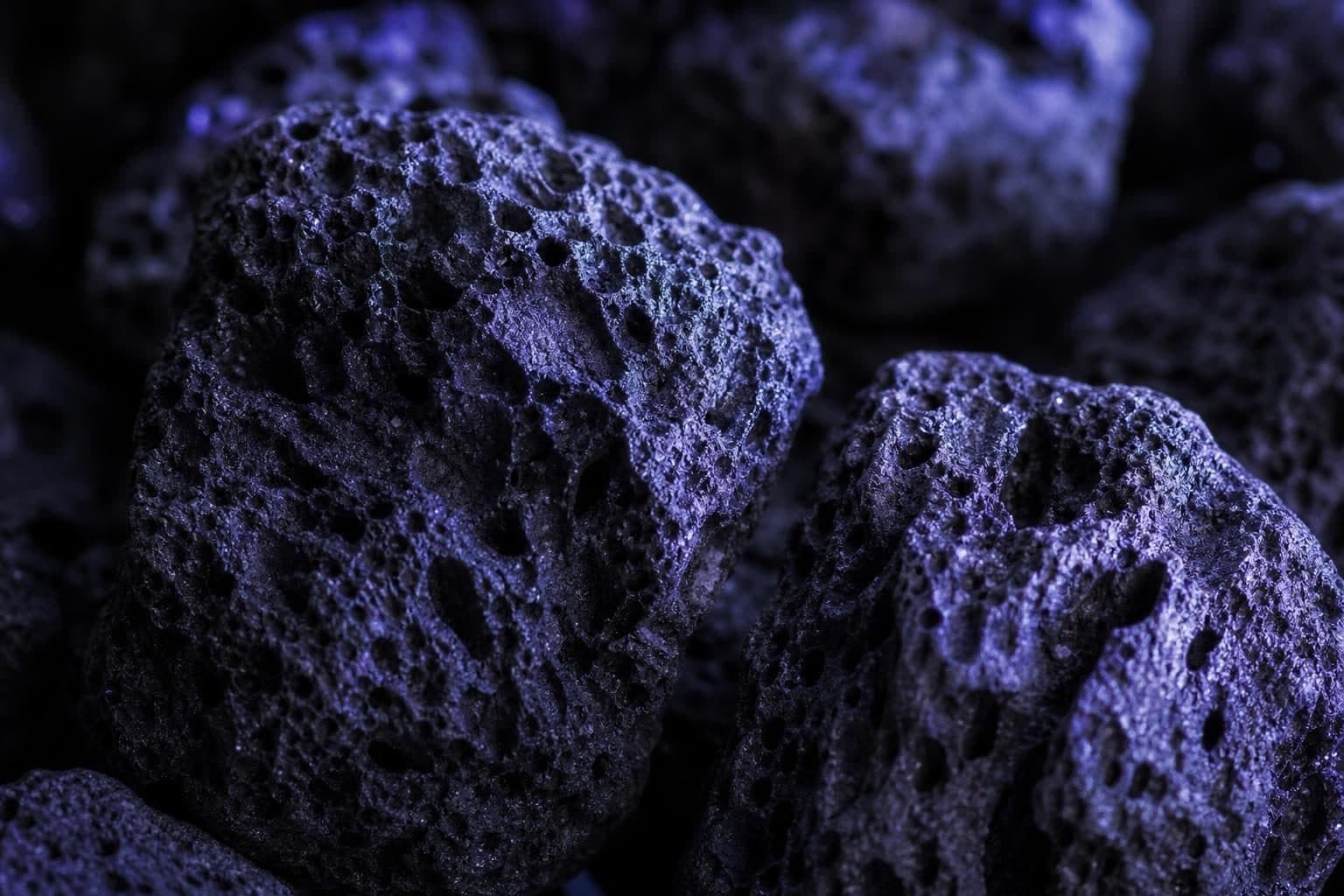
Take a 100-liter steel tank, fill it with methane to 35 bar at 25 °C, and it holds roughly 2.4 kg of gas. Pack the same tank with a good activated carbon, fill it to the same 35 bar, and the figure rises to somewhere near 10–12 kg. Nothing about the tank changed. The extra gas sits on the inside walls of billions of pores, held there by the same weak forces that make dust cling to a screen. That is adsorbed natural gas, usually shortened to ANG, and the whole field comes down to a single question: how many molecules can a solid be made to hold, and how many of them can it be made to give back?
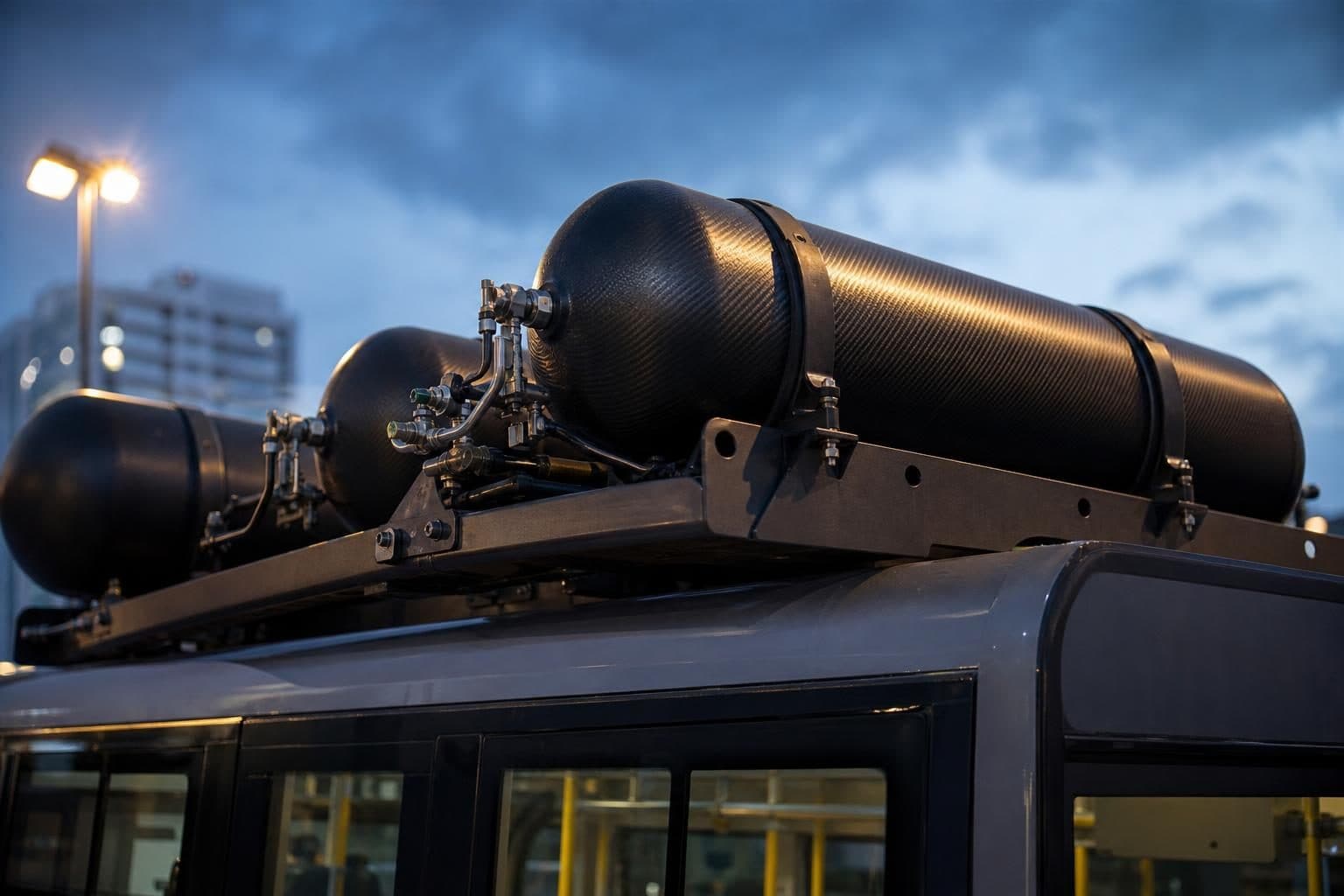
A compressed natural gas (CNG) cylinder solves the same problem with brute pressure, 200–250 bar, and a liquefied natural gas (LNG) tank with cold, about −162 °C. ANG tries to reach useful density at room temperature and a pressure that a small, cheap compressor can produce. The idea is old and the physics is well understood. Even so, after decades of research, adsorbed natural gas storage is still mostly a laboratory and pilot technology, and the reasons are thermal, practical and economic.
How it works: methane on a surface
Adsorption (with a "d") is the attachment of molecules to the surface of a solid. Absorption, the more familiar word, is a gas dissolving into a liquid or a bulk material. In an ANG tank nothing dissolves. Methane molecules approach the carbon or framework wall, feel a van der Waals attraction from the atoms around them, and settle into a layer that is much denser than the free gas a few nanometers away. Understanding how it works starts at the scale of a single pore, only a few molecules wide.
This matters because methane cannot be liquefied by pressure at room temperature. Its critical temperature is about −82.6 °C, so above that point no amount of squeezing turns it into a liquid, and the gas simply becomes a denser supercritical fluid. Inside a narrow pore the picture changes. The walls pull on the molecules from two sides, and the adsorbed layer reaches a density closer to a liquid than to a gas, even at 35 bar. The physical bond is weak, about 10–17 kJ/mol for methane on activated carbon, so it breaks again as soon as the pressure drops. No chemical reaction takes place and the methane that leaves the tank is the same methane that went in.
Pore size decides almost everything
A surface only helps if gas can reach it, and the walls only pull hard if they are close together. Molecular simulations of simple slit pores put the ideal width at about 0.8 nm, just enough room for two layers of methane, one on each wall. Wider pores leave a band of ordinary compressed gas in the middle. Narrower pores hold methane so tightly that too much of it refuses to leave at low pressure. When heat and mass transfer are included in the model, slightly wider pores of 1.5–2.5 nm come out ahead, because the gas has to move through the bed quickly during fill and discharge.
Surface area is the other headline number. Commercial activated carbons typically offer around 1,000–2,000 m² per gram, and research carbons have been reported above 3,500 m² per gram, for example a carbon made from olive stones at 3,551 m²/g. A single gram of such material has an internal area larger than a tennis court. Area alone is not the goal, though. What counts in a vehicle is how much gas fits per liter of tank, so a fluffy, high-area powder that packs at a low density can lose to a denser carbon with less area.
Reading an adsorption isotherm
An isotherm is a plot of how much gas a material holds against pressure, at one fixed temperature. For methane on a microporous carbon at 25 °C it rises steeply at low pressure and then bends over, a shape chemists call Type I. Most of the gain arrives in the first 30–40 bar. Going from 35 to 70 bar adds far less than going from 0 to 35 bar did, and that flattening is why ANG designs cluster at 35–50 bar.
Two kinds of numbers appear on these plots, and mixing them up causes most of the confusion in published comparisons. "Excess" uptake counts only the extra molecules that the surface attracts beyond what the same pore volume would hold as free gas. "Total" uptake counts everything inside the tank, adsorbed layer plus compressed gas in the gaps. A designer cares about a third number, the deliverable or working capacity: total gas at the full pressure minus whatever remains at the lowest pressure the engine can use.
Adsorbed natural gas storage capacity: V/V and the DOE targets
Capacity in this field is quoted in V/V, the volume of gas at standard temperature and pressure that one volume of tank holds. A tank rated 180 V/V stores the methane that would fill 180 liters at atmospheric pressure in every liter of vessel. Plain compressed methane at 35 bar and 25 °C works out to roughly 34 V/V. CNG at 250 bar and 25 °C reaches about 263 V/V.
In 1993 the US Department of Energy set a storage target for adsorbents of 150 V/V at 35 bar and 298 K. It was later raised to 180 V/V, a level chosen so that an ANG tank at 35 bar would approach the energy density of a CNG tank of that era. Around 2012 the DOE's ARPA-E program raised the bar again with a volumetric target of 0.188 g of methane per cm³, equal to the density of CNG at 250 bar and 298 K and to about 263 V/V, plus a gravimetric target of 0.5 g of methane per gram of adsorbent.
| Storage case (25 °C) | Pressure | Approx. V/V | Methane in a 100 L tank |
|---|---|---|---|
| Empty tank, compressed gas only | 35 bar | ≈34 | ≈2.4 kg |
| DOE target from 1993 | 35 bar | 150 | ≈9.8 kg |
| Revised DOE target | 35 bar | 180 | ≈11.8 kg |
| ARPA-E volumetric target (= CNG) | 35–65 bar | 263 | ≈18.8 kg |
| CNG cylinder | 250 bar | ≈263 | ≈18.8 kg |
The 100-liter column is simple arithmetic and worth doing once yourself. Methane at 25 °C and 1 atm weighs about 0.656 kg per cubic meter. At 180 V/V, a 100-liter tank holds 18,000 liters of gas at standard conditions, so 18 m³ × 0.656 kg/m³ ≈ 11.8 kg. At roughly 2.57 kg of natural gas per gasoline gallon equivalent, that is about 4.6 GGE, compared with about 7.3 GGE in a 100-liter CNG cylinder at 250 bar. The adsorbent multiplies the low-pressure capacity about fivefold and still lands at around two thirds of what high-pressure compression delivers. For other tank sizes the tank capacity calculator does the same conversion.
Total uptake is not what the engine gets
The 2013 benchmark study by Peng and co-workers in the Journal of the American Chemical Society measured six metal-organic frameworks under one protocol at 298 K. HKUST-1, a commercially available copper framework, reached about 227 V/V total at 35 bar and 267 V/V at 65 bar, beating any earlier room-temperature value. Ni-MOF-74 looked almost as good on total uptake, 228 V/V at 35 bar. The working capacity told a different story. Taking 5 bar as the lowest pressure an engine fuel system can use, HKUST-1 delivered 190 V/V between 65 and 5 bar, and Ni-MOF-74 only 129 V/V, because it holds methane so tightly that much of the gas stays behind below 5 bar.
Those figures also assume a perfect single crystal. Real adsorbent is a powder, pellet or monolith with gaps between particles, and the authors estimated that a 25% packing loss would push the required material-level capacity to about 330 V/V. One reported case shows the scale of the problem: shaping a nickel-based framework into pellets cut its uptake from about 230 to 100 V/V at 34 bar. Packing density is the least glamorous number in ANG research and, for a working tank, often the decisive one.
Activated carbon, MOFs and other adsorbents
Activated carbon is the workhorse. It is made by carbonizing coconut shell, coal, wood, fruit stones or polymers and then "activating" the char with steam, carbon dioxide or chemicals such as potassium hydroxide to open up the pore network. The best adsorbed natural gas activated carbon grades reach storage values of up to about 200 V/V, and a monolithic carbon has been reported at 170 V/V delivered at 65 bar. Carbon is cheap, stable in moist air, tolerant of trace contaminants and can be pressed into dense blocks that fill a vessel with few voids.
Metal-organic frameworks, or MOFs, are crystals built from metal clusters joined by organic linkers. Their pores are uniform and can be tuned by changing the linker. Simulation studies in the early 2000s used that freedom to predict that new IRMOF structures could beat the best carbons. MOFs hold the volumetric records, but they cost far more per kilogram, some degrade in humid air, and many lose much of their capacity when compacted. The metal hydrides and MOFs page covers the same materials from the hydrogen side, where the problems are similar and the binding is weaker still.
| Adsorbent | Reported methane figure (25 °C unless noted) | Heat of adsorption | Notes |
|---|---|---|---|
| Activated carbons (best grades) | up to ≈200 V/V storage | ≈10–17 kJ/mol | cheap, stable, wide pore distribution |
| Carbon monolith | 170 V/V delivered at 65 bar | n/a | dense block, few voids |
| HKUST-1 (Cu MOF) | 227 V/V total at 35 bar; 190 V/V working, 65→5 bar | 17.0 kJ/mol | commercially available |
| Ni-MOF-74 | 228 V/V total at 35 bar; 129 V/V working, 65→5 bar | 21.4 kJ/mol | binds too strongly, large heel |
| IRMOF-993 (simulated) | 181 V/V at 35 bar | 15.5 kJ/mol | hypothetical structure |
Zeolites, mesoporous silicas such as MCM-41, porous organic polymers and carbon nanotubes have all been measured too. None of them has displaced carbon outside the laboratory. Carbon nanotubes, for example, reached about 160 V/V at 35 bar and 25 °C in experiments, a respectable figure at a much higher material cost.
Heat of adsorption and thermal management
Here is the part that tends to surprise people who first meet the technology. Adsorption gives off heat, and desorption absorbs it. Every mole of methane that settles onto the adsorbent releases roughly 10–20 kJ, depending on the material, the same energy it will demand back on the way out. In a laboratory isotherm the sample sits in a thermostat and the heat goes nowhere. In a 50-liter vehicle tank filled in five minutes, it has nowhere to go either, because a packed carbon bed conducts heat poorly.
During a fast fill the center of the bed can warm by tens of degrees. Warmer carbon holds less methane, so the tank reaches 35 bar early and stops accepting gas with part of its capacity unused. When the gas settles and cools, the pressure drops and the tank reads less than full. During discharge the reverse happens: the bed cools as methane leaves, cold carbon holds gas more tightly, and the pressure falls toward the engine's cutoff with fuel still on board. Modeling studies of carbon-filled cylinders consistently place the largest temperature swings in the middle of the bed, farthest from the wall.
Engineers have attacked the problem from several directions:
- slow or staged fills, which give heat time to reach the wall
- internal fins, tubes or heat pipes running through the adsorbent
- carbon blended with graphite or other high-conductivity fillers
- warming the tank with engine coolant or exhaust heat during discharge
Each fix adds weight, volume or cost, and the adsorbent with the highest heat of adsorption, which looks best on a static isotherm, suffers most from these swings. That trade-off is one reason Ni-MOF-74 lost out to HKUST-1 on practical working capacity.
The heel: gas that stays behind
The word heel is used in two ways, and both reduce what the driver can use.
The first is the low-pressure heel. An engine fuel system needs some minimum supply pressure, often taken as about 5 bar. An adsorbent's isotherm is steepest at low pressure, so a good carbon still holds a noticeable share of its gas between 5 bar and atmospheric pressure. That methane stays in the tank as dead weight. Strong binders such as Ni-MOF-74 make the problem worse, and so does a cold bed at the end of a long drive.
The second is the contaminant heel. Pipeline gas is not pure methane. It carries a few percent of ethane and propane, traces of heavier hydrocarbons, water, and sulfur-based odorants. These larger molecules bind to carbon more strongly than methane and do not leave at room temperature. Over hundreds of fill cycles they accumulate and occupy pores that methane would otherwise use, so capacity drifts down. Designs counter this with a guard bed at the inlet that catches the heavier species and can be replaced or regenerated, and with careful drying of the gas. If a project plans to run on raw field gas or partly upgraded biogas, the contaminant heel deserves more attention than the headline V/V.
ANG vs CNG: tank, station and energy
Compared tank against tank, CNG wins on energy per liter. Compared system against system, the picture is closer, because pressure drives most of the cost of a CNG station and much of the weight of a CNG tank. For a fleet operator the deciding question is less how it works than what each stored kilogram costs.
| ANG | CNG | |
|---|---|---|
| Typical working pressure | 35–50 bar (500–725 psi) | 200–250 bar (2,900–3,600 psi) |
| Methane per liter of tank, 25 °C | ≈0.10–0.12 kg at 180 V/V | ≈0.19 kg at 250 bar |
| Tank shape | cylinder or conformable shape | cylinder, sometimes long tubes |
| Compressor | one or two stages | three to five stages |
| Thermal effects during fill | large, needs management | moderate heat of compression |
| Gas left at engine cutoff | significant heel | small |
The compression saving is easy to estimate. The ideal isothermal work to compress a gas grows with the logarithm of the pressure ratio. Starting from a household line at roughly atmospheric pressure, compressing to 35 bar takes about 64% of the work needed to reach 250 bar. Starting from a 4 bar distribution main, the figure falls to about 53%. Real compressors are less efficient than the ideal, but the ratio holds roughly, and lower outlet pressure also means cheaper seals, valves and vessels.
So the ANG vs CNG decision is mostly about where the cost sits, and an ANG vs CNG comparison done on tank volume alone will always favor compression. If a depot can afford a high-pressure station and the vehicles have space for cylinders, CNG is the simpler choice. If the target is a car or scooter filled from a small home compressor, or a container that must fit an odd space, the low-pressure route looks more attractive. The CNG vs LNG comparison runs the same exercise for the other main storage route.
Conformable tanks and the shape question
A CNG cylinder at 250 bar has to be round, because a cylinder or sphere carries pressure in pure tension and anything flatter bends. At 35 bar the stresses are about seven times lower, and that opens up shapes that would be impractical at full pressure: flat slabs under a floor, tanks with several connected cells, vessels that follow the curve of a scooter frame.
This was one of the main ideas behind the US ARPA-E MOVE program (Methane Opportunities for Vehicular Energy), announced in 2012 with $30 million for 13 projects on cheaper tanks and home refueling. REL, Inc. received $3 million for a conformable tank with an internal foam core. Texas A&M University received $3 million for highly adsorbent materials aimed at low-pressure tanks. United Technologies Research Center began a conformable tank design under MOVE in 2012 and in 2016 licensed it to Adsorbed Natural Gas Products, Inc., which paired the composite tank with activated carbon at an operating pressure below 1,000 psi (about 69 bar). Conformable designs pay for themselves only if the internal walls and partitions take up less volume than the space they reclaim, and that margin is smaller than drawings suggest. For a closer look at ordinary vessel construction, the guide to natural gas storage tanks covers Type I to IV cylinders and their standards.
Where adsorbed natural gas storage fits
Light vehicles
Passenger cars were the original target for adsorbed natural gas storage for vehicular applications, and they are where the DOE numbers came from. The attraction was a tank that fills from a modest compressor at home or at a workplace and fits under the floor. The obstacle is range: at two thirds of CNG's density, after heel and packing losses, an ANG car either carries a larger tank or travels less far.
Two- and three-wheelers
For scooters, motorcycles and auto-rickshaws, space and weight matter more than outright range, and a heavy 250 bar cylinder is a poor fit for a frame designed around a small fuel tank. Low-pressure, shape-flexible tanks suit these vehicles better on paper. The market for gas-fueled two- and three-wheelers sits mostly in South and Southeast Asia, where CNG auto-rickshaws already run in large numbers.
Bulk storage and transport
Large ANG vessels have been proposed for moving gas by truck to customers off the pipeline network, and for stationary buffers at depots. Here weight matters less and thermal management is easier, because fills and draws can be slow. The economics compete with CNG tube trailers, which are proven, and with small-scale LNG.
Flare and stranded gas
Associated gas at remote oil wells is often flared because a pipeline is too expensive for the volume. A low-pressure adsorbed system that can be filled with a small compressor at the wellhead has been suggested as one way to collect it. Raw associated gas is rich in ethane, propane and water, though, so the contaminant heel and pre-treatment dominate the design. The stranded gas page covers the alternatives in more detail.
Upgraded biogas
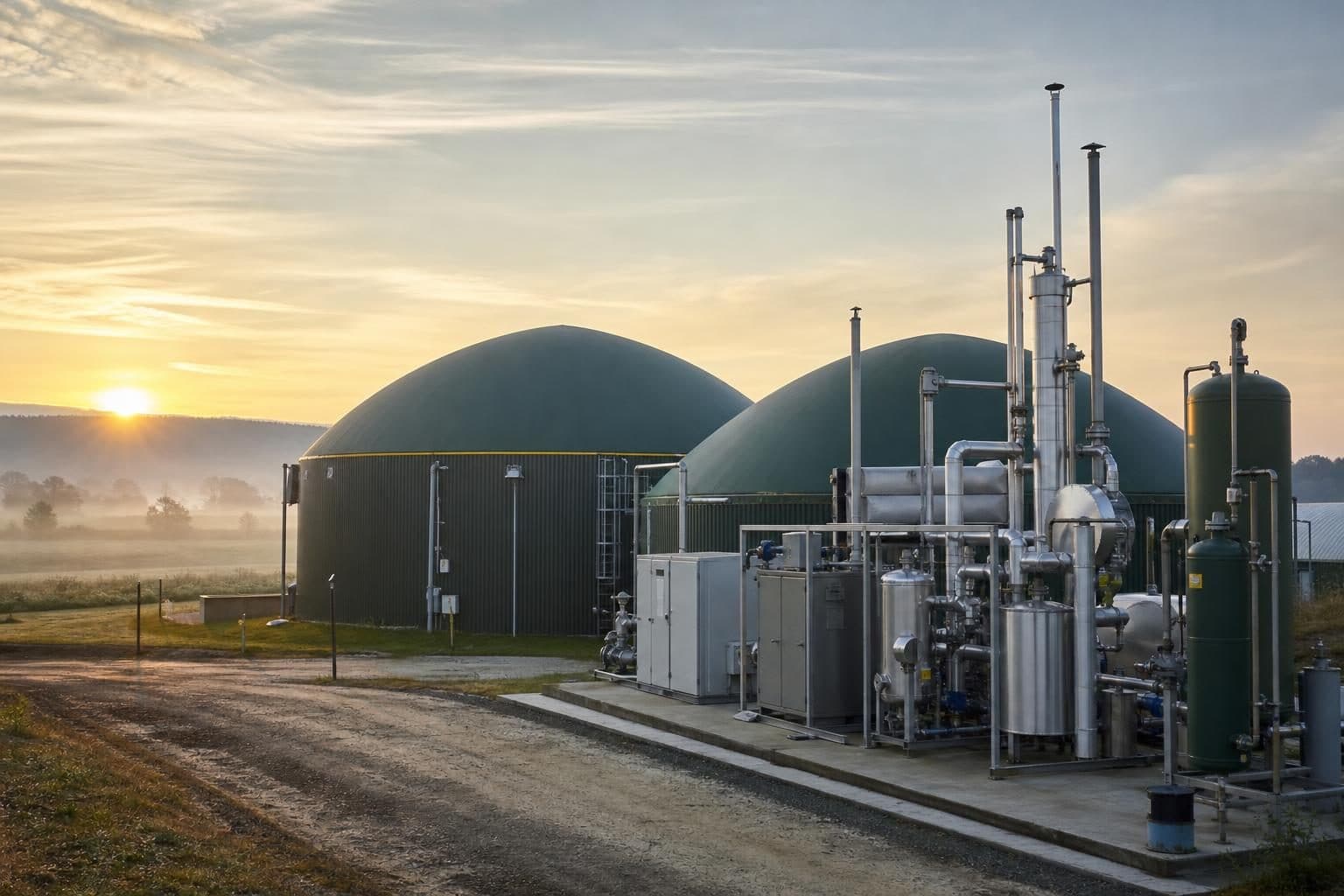
The same tanks work with biomethane once it is cleaned to pipeline quality. Small farm digesters that produce modest volumes have prompted interest in adsorbed natural biogas cylinders filled by low-cost compressors, though carbon dioxide and hydrogen sulfide must be removed first, because both bind to carbon more strongly than methane does.
Research programs and companies
The principle has been understood for a long time. Activated carbon's appetite for gases was used in gas masks during the First World War, and the 1993 DOE target shows that adsorbed natural gas storage technologies were already a defined research area in the early 1990s. Simulation work in 2004, including a Langmuir paper by Düren and colleagues, mapped out what an ideal methane adsorbent would need: high surface area, high free volume, low framework density and a strong but not excessive heat of adsorption.
Commercial efforts ran in parallel and in several countries. In Israel, Angstore Technologies, founded in 2002 in an Ashkelon technology incubator, developed an ANG system for converting vehicles to natural gas; Energtek Inc., then a US-listed company, bought it in 2007 and continued the work on ANG vehicle tanks and filling systems in the late 2000s. In the United States, the MOVE program funded several adsorbed tank projects from 2012. SRI International built a proof-of-concept tank storing gas in a solid carbon sorbent at about 500 psi, and its spin-off BlackPak received a further $4.6 million cooperative agreement from ARPA-E in 2014, targeting a system-level energy density above 6 MJ/L at 500 psi. That figure is a useful yardstick: a CNG cylinder at 250 bar holds roughly 9–10 MJ/L of gas, and a diesel tank about 36 MJ/L of fuel.
Limits and current status
The 180 V/V target has been met by several materials, at least on a crystal basis and at the material level. The newer 263 V/V target, set to match CNG at 250 bar, has not been reached by a packed adsorbent in a real tank once packing losses and the heel are counted. MOFs that come close on paper are expensive to make in tonnage, some are sensitive to moisture, and few keep their performance after being pressed into dense shapes.
Meanwhile, the competition did not stand still. Type III and Type IV composite cylinders cut the weight of CNG storage sharply, and natural gas vehicle markets grew around 200–250 bar infrastructure in Asia, South America and Europe. An ANG vehicle has to beat a mature system on cost, range and convenience at the same time, and so far none has done so at production scale.
Research continues on denser carbon monoliths, MOF composites that survive compaction and tanks with built-in heat exchange. If you follow the field, the number worth watching is not peak uptake at 65 bar but deliverable V/V measured on a full-size tank after several hundred cycles. Published values of that kind are still rare.