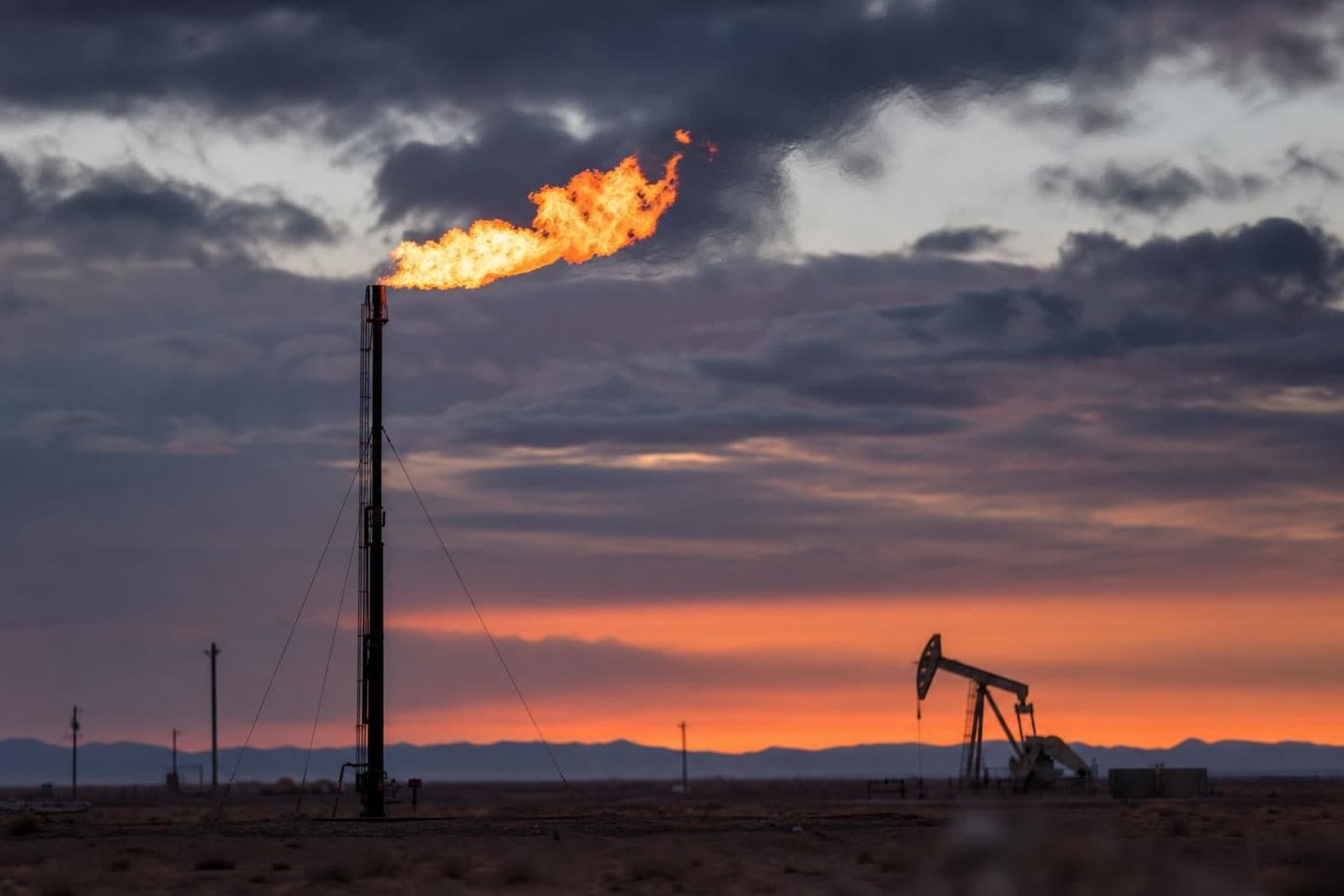
On night-time satellite images, the oil fields of Siberia, the Niger Delta, Iraq and West Texas show up as clusters of bright points far from any city. Each point is a flare: a stack burning the gas that came up with the oil because no one had a way to sell it. The World Bank's Global Gas Flaring Tracker, built on those satellite readings, counted 167 billion cubic meters (bcm) of gas burned this way in 2025.
That figure is the highest since 2019, and it rose for the third year running. The World Bank valued the lost gas at about US$54 billion. Against that, there were real reductions: the United States made the largest absolute cut in 2025, 0.4 bcm or 7 percent, and Kazakhstan has reduced its flaring by 87 percent since 2012.
The numbers come from orbit because few countries meter their flares reliably. Sensors on three NOAA weather satellites detect the heat of each flame, and the Earth Observation Group of the Payne Institute at the Colorado School of Mines models the readings into volumes for the World Bank. The same tracker puts the up-front capital needed to end routine flaring worldwide at US$70–100 billion. The US reduction was credited largely to new pipeline capacity out of the Permian Basin, a reminder that where volumes are large enough, the pipe still wins.
Stranded, associated and flared
Stranded gas is gas that has been discovered but has no economic route to a buyer. A small offshore pocket, a field hundreds of kilometers from the nearest transmission line or a reservoir in a country with no domestic market can all be stranded. Much of it simply stays in the ground.
Associated gas is a different case, because it comes out whether anyone wants it or not. It is dissolved in the crude oil or sits above it in the reservoir, and it separates as the oil is brought to the surface. An oil producer whose field has no gas outlet has three choices: reinject the gas into the reservoir, use some of it on site, or burn it. The World Bank's Zero Routine Flaring by 2030 initiative defines routine flaring as flaring during normal oil production in the absence of facilities or geology to reinject, use or market the gas, and its endorsers commit to ending it no later than 2030.
Flaring is the least bad of the disposal options. Venting releases methane directly, and methane traps far more heat than the carbon dioxide produced by burning it. Flares are not perfect, though: wind, low gas flow and poor tip design leave some methane unburned.
Why pipelines miss small sources
Pipeline economics depend on volume and time. A transmission line is paid off over decades of steady flow, and an associated-gas stream from a shale well often falls steeply within its first year or two of production. Nobody builds a pipe for a supply that might be gone before the pipe is paid for. Remote conventional fields have the opposite problem: steady gas, but too far from anyone who wants it.
Small-scale monetization starts from a different premise. Equipment is modular, skid-mounted or trailer-mounted, and moves to the next site when the current one declines. Per unit of gas it costs more than a large plant, but it never has to be paid off by a single field.
A worked example: one flare stack
Consider a flare burning 30,000 cubic meters of gas a day, close to a million standard cubic feet. At about 0.68 kg/m³ for methane at 15 °C and atmospheric pressure, that is roughly 20 tonnes of gas a day, a little more if the gas is rich in ethane and propane, as associated gas usually is.
At the EIA's average heat content of about 1,037 Btu per cubic foot, the same stream carries around 1,100 GJ a day, an average thermal output of roughly 13 MW. Turned into electricity at around 40 percent efficiency, that would be about 5 MW of continuous power. Loaded into trailers, 20 tonnes a day would fill about two composite CNG modules of 9–10 tonnes each. Those two numbers frame the choices below.
Mini-LNG
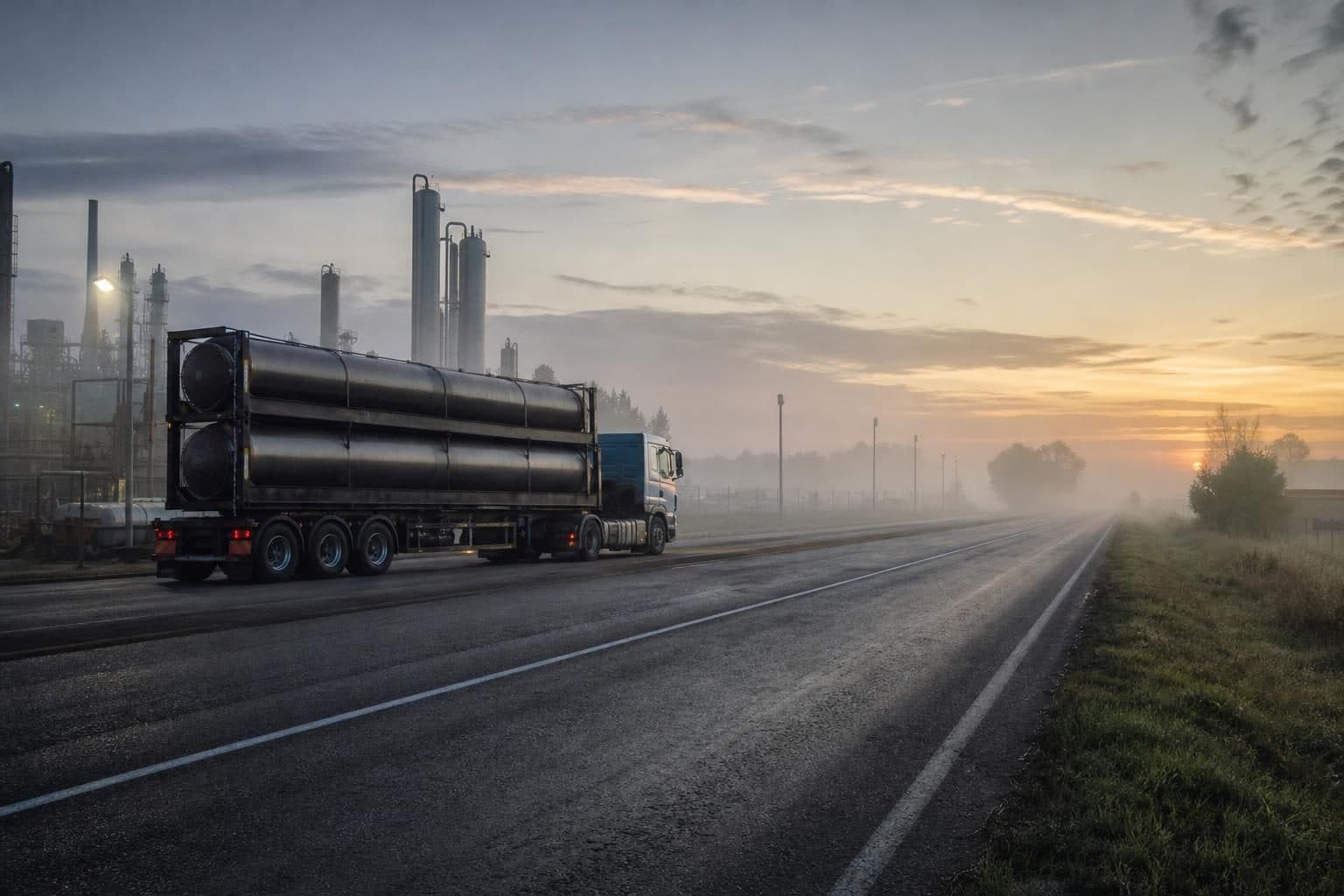
Small liquefaction units, sometimes called mini- or micro-LNG, cool gas from a single site to about −162 °C and load it into road tankers. The gas first has to be cleaned: carbon dioxide, water, hydrogen sulfide and heavier hydrocarbons would freeze or foul the cold box. The liquid is then dense enough, about 422 kg/m³, that a single tanker carries roughly 19 tonnes, close to a day's output from the flare in the example.
The heavier hydrocarbons removed during treatment are a bonus. Associated gas is often rich in ethane, propane and butane, and natural gas liquids sell at a premium, so a small plant can earn from two products. The catch is energy: small liquefiers use more power per tonne than large export plants, and that power usually comes from burning part of the gas.
LNG produced this way reaches the same customers as any other LNG, from truck fleets to off-grid factories, as described on the page about LNG trucking.
CNG trucking
Compression is simpler than liquefaction. A compressor, a dryer and a filling post load trailers to 250 bar, and the trailers drive to a buyer or to a pipeline injection point. The equipment is cheaper and faster to install, and it handles changing flow rates better than a liquefier. The limit is payload: a CNG trailer carries about half as much gas as an LNG tanker, so routes have to be shorter. The full logistics of trailers, swap schedules and decompression are covered under virtual pipelines.
| Option | Main equipment | Best suited to | Main limitation |
|---|---|---|---|
| Mini-LNG | Treatment, liquefier, cryogenic storage | Larger, steadier flows, long trucking routes | Capital cost and energy use per tonne |
| CNG trucking | Dryer, compressor, tube trailers | Small or declining flows, short routes | Lower payload per truck |
| Gas-to-power | Gas engines or turbines, gas conditioning | Sites with a local power demand or grid link | Needs a buyer for the electricity |
| Reinjection | High-pressure compressor, injection well | Fields where pressure support helps oil recovery | Gas earns nothing directly |
Gas-to-power at the wellhead
Burning the gas in an engine instead of a flare is the most direct use. Gas engines and small turbines on the pad can replace diesel generators on drilling rigs, power pumps and compressors, or feed a nearby grid or village. In remote fields with no grid, the power has to be used locally, and that limits the size of the project to the size of the demand. Gas conditioning is still needed, since raw associated gas carries liquids and sometimes hydrogen sulfide that damage engines.
One more recent buyer for that electricity is computing. Operators in some North American basins have placed containerized data processing loads beside well pads, using flare gas that would otherwise have no outlet. The loads can be moved, like the generators, when the gas declines.
Adsorbed storage and other small routes
Adsorbed natural gas, gas stored in a porous solid at around 35–60 bar, has been proposed for small stranded sources because the filling equipment needs far less compression than CNG. Transport capacity per truck is lower than compressed gas at 250 bar with today's adsorbents, so it has mostly been studied for local distribution and vehicles. The physics and the state of the materials are covered on the page about adsorbed natural gas.
Other routes exist on paper and at pilot scale: small gas-to-liquids units that make synthetic diesel or methanol, and conversion of gas into hydrogen with the carbon captured. Their equipment is more complex than a compressor or a generator, and few have run commercially at single-field scale.
How these options compare with simply building a pipe depends on the same distance and volume logic as any virtual pipeline natural gas supply, and on what the gas is worth at the nearest point of sale. Why so many countries want that gas used at all is the subject of why natural gas.