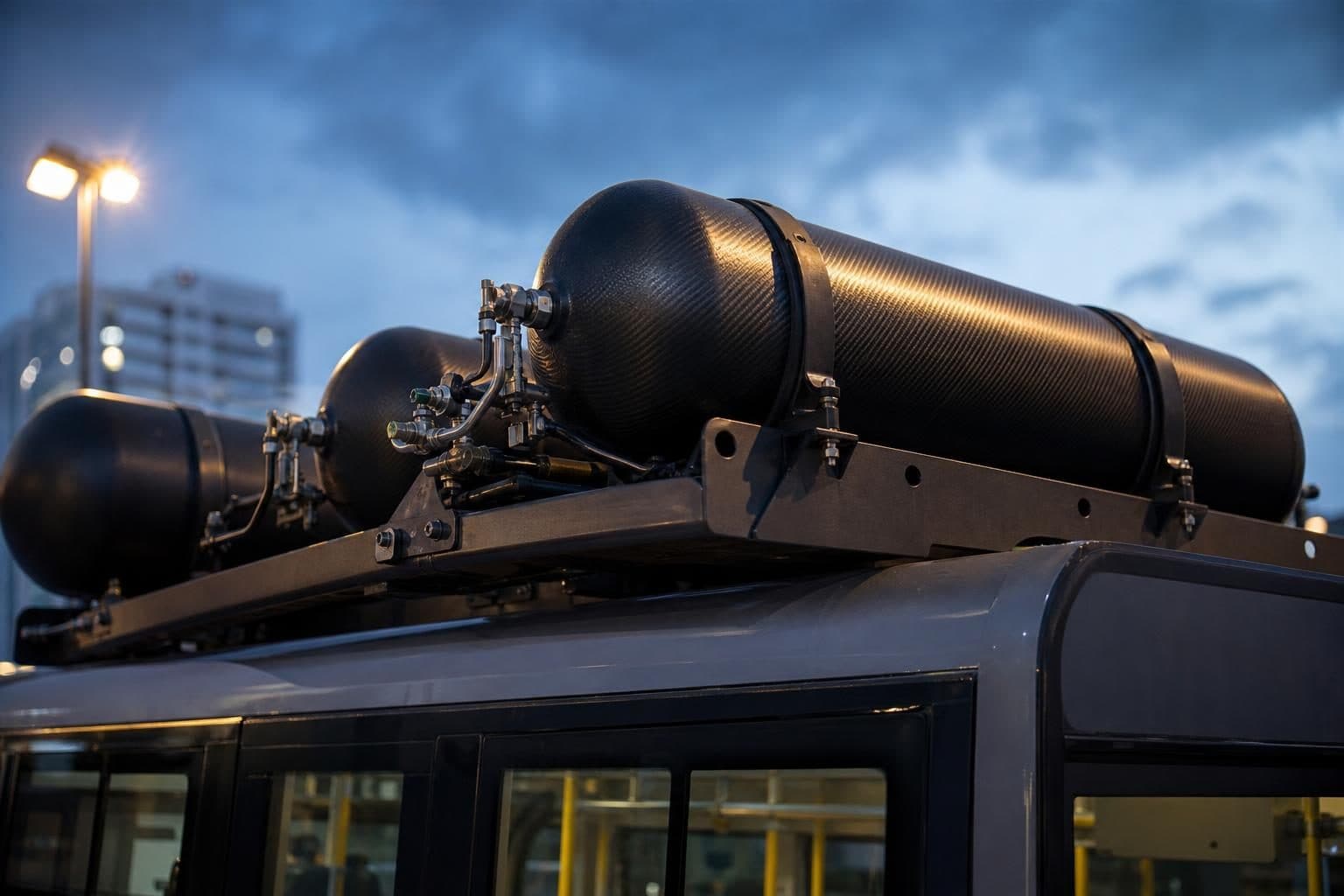
Look under a city bus that runs on natural gas and the fuel is not underneath at all. It sits on the roof, in a row of long cylinders under a fairing, each one charged to about 3,600 psi. The weight up there was a design headache for the engineers who placed it, and the cylinders themselves are where most of the cost of a gas vehicle goes. Natural gas storage tanks look like simple bottles. They are some of the most heavily regulated pressure vessels a member of the public ever drives around with.
Three physical routes exist for packing natural gas into a useful volume. Compressed natural gas (CNG) cylinders hold it at 200–250 bar, cryogenic tanks hold liquefied natural gas (LNG) at about −162 °C, and adsorbed gas tanks hold it on a porous solid at 35–50 bar. Behind them sit station storage banks and, at the largest scale, underground reservoirs that hold a region's winter supply. CNG cylinders are by far the most common on the road, and they come in four construction types.
The four CNG tank types
The industry sorts high-pressure cylinders into four natural gas tank types, numbered by how much of the pressure load is carried by metal and how much by fiber composite. The same numbering appears in ISO 11439, in CSA/ANSI NGV 2 and in UN ECE R110, where the types are called CNG-1 to CNG-4.
Type I: all metal
A Type I cylinder is a single piece of steel, or occasionally aluminum, with no wrap. It is the heaviest construction, at roughly 1.4 kg per liter of water volume (about 3 lb per liter), and the cheapest, at an estimated production cost of around $5 per liter. Type I tanks are common where weight matters less than price: taxis and private cars converted in South Asia and South America, stationary storage at fueling stations, and cascades of tubes on trailers. Steel tolerates rough handling and the cylinders are simple to inspect.
Type II: hoop-wrapped metal
Type II keeps a load-bearing steel or aluminum liner and adds a fiber composite wrap around the cylindrical middle section only. Metal and composite share the structural load roughly equally. The result is 30–40% lighter than Type I and costs about 50% more. The domed ends stay bare metal, so a Type II cylinder still looks like a steel tank at each end.
Type III: metal liner, full wrap
A Type III cylinder has a thin one-piece liner, usually aluminum, that keeps the gas in, and a full overwrap of carbon fiber that carries the pressure. Weight falls to roughly 0.3–0.45 kg per liter. Cost rises to about twice Type II and three and a half times Type I.
Type IV: plastic liner, full wrap
Type IV removes the metal entirely. A thermoplastic liner, typically high-density polyethylene or polyamide, is wound with carbon fiber or a carbon and glass hybrid. Weight is similar to Type III and often slightly lower, and Type IV has become the common choice for buses and heavy trucks, where every kilogram saved on the roof or the back of the cab adds payload. A polymer liner allows very slow permeation of gas through the wall, so the standards set permeation limits that metal-lined designs do not need.
| Type | Construction | Weight per liter water volume | Relative cost | Typical use |
|---|---|---|---|---|
| I | all steel (or aluminum) | ≈1.4 kg (3.0 lb) | 1× (≈$5/L) | cars in price-sensitive markets, station storage |
| II | metal liner, hoop wrap | 30–40% below Type I | ≈1.5× | light and medium vehicles |
| III | metal liner, full carbon wrap | ≈0.3–0.45 kg | ≈3.5× | buses, trucks, premium cars |
| IV | polymer liner, full carbon or hybrid wrap | ≈0.3–0.45 kg | ≈3.5× | buses, trucks, high-pressure transport |
For any choice between the natural gas tank types, the trade is simple to state: Type I buys cheap capacity with weight, and Types III and IV buy back weight with money. Above about 5,000 psi (345 bar), the full-wrap designs are the only practical option. Bulk gas transport modules and hydrogen tanks are built that way for the same reason, and the hydrogen storage guide follows the Type IV story up to 700 bar.
Standards and pressure ratings for CNG storage tanks
Four documents come up again and again for CNG storage tanks on vehicles:
- ISO 11439 sets minimum requirements for lightweight refillable cylinders used only for on-board storage of CNG as automotive fuel, covering Types 1 to 4 and using 200 bar as its reference working pressure.
- CSA/ANSI NGV 2 is the North American equivalent, built around the 3,600 psi (about 248 bar) service pressure used in the United States and Canada.
- UN ECE R110 covers CNG and LNG components for vehicles approved in Europe and in the many countries that follow UNECE vehicle regulations.
- FMVSS 304, issued by the US National Highway Traffic Safety Administration, sets container integrity and labeling requirements for CNG fuel containers on US vehicles.
These standards share a philosophy. A cylinder design has to survive a long list of qualification tests: hydraulic burst, pressure cycling for thousands of fills, bonfire exposure, gunfire penetration, drop tests, chemical exposure for composites, and flaw tolerance for cuts in the wrap. A minimum burst pressure is set as a multiple of the working pressure, and the multiple depends on the fiber. Glass fiber is prone to stress rupture under sustained load, so glass-wrapped designs must be built with a larger margin than carbon-wrapped ones. Every production batch is then sampled and tested again.
Pressure ratings are stated as a settled pressure at a reference temperature. That detail matters at the pump. A fast fill heats the gas, so a dispenser that stops at exactly 3,600 psi on a hot day leaves the tank short once it cools, while a dispenser with temperature compensation allows a higher momentary pressure to reach the same settled fill. Building and fueling codes such as NFPA 52 then govern how the tanks are installed on the vehicle and how the stations that fill them are laid out.
Service life and inspection
A vehicle CNG tank is not meant to last as long as the vehicle could. The US Department of Energy's Alternative Fuels Data Center gives a useful life of 15 to 20 years, depending on construction and on the standard the tank was certified to. Some carbon-fiber Type III and IV designs have been rated for up to 30 years. Whatever the number, it is printed on a label that reads "DO NOT USE AFTER" followed by a date, and there is no procedure to requalify a CNG fuel tank once that date has passed. The tank must be replaced.
Expiry dates catch owners out. No national system in the United States reminds anyone when a tank is about to expire, so the responsibility falls on the owner or fleet manager, and used natural gas vehicles change hands with tanks that have only a year or two left. If you are buying one secondhand, read the cylinder labels before the odometer.
Inspection intervals in the United States follow the FMVSS 304 label language and NGV 2:
- light-duty vehicles: every 36 months or 36,000 miles, whichever comes first
- vehicles above 10,000 lb (4,536 kg) gross vehicle weight rating: every 12 months
- any vehicle: after a fire, a collision or any other event that could have damaged the tank
The inspection is mostly visual, done by a certified inspector, and looks for cuts and abrasion in the composite, impact damage, chemical attack, corrosion on metal parts, loose brackets and the condition of pressure relief device vent lines. Tanks mounted under the floor take more stone chips and curb strikes than roof-mounted ones, and they tend to fail inspection more often. When a tank is retired, it has to be vented and purged with nitrogen by a qualified facility before it is cut up, following practices such as CSA EXP 2.1.
Capacity: from water volume to gasoline gallons
Tank capacity is always quoted first as water volume, the internal volume in liters. Turning that into usable fuel takes three steps: gas density at the rated pressure, the mass of gas, and an energy equivalent that drivers and fleet managers can compare with liquid fuels.
Start with density. Pure methane at 15 °C weighs about 168 kg per cubic meter at 200 bar and about 199 kg/m³ at 250 bar, according to NIST reference data. Pipeline gas is slightly heavier because it contains some ethane and nitrogen, but methane is a good working assumption.
Then mass. An 80-liter cylinder at 200 bar holds 0.080 m³ × 168 kg/m³ ≈ 13.4 kg of gas. Fill the same cylinder to 250 bar and it holds about 15.9 kg, a gain of 19% for 25% more pressure, because methane gets harder to compress as it gets denser.
Finally energy. The Alternative Fuels Data Center defines one gasoline gallon equivalent (GGE) as 5.66 lb, or about 2.57 kg, of CNG, which is also about 123.6 standard cubic feet. Dividing gasoline's energy into natural gas's lower heating value of 20,160 Btu per pound gives that figure. Doing the same with diesel's 128,488 Btu per gallon gives a diesel gallon equivalent (DGE) of about 6.37 lb, or 2.89 kg, of CNG.
| 80 L cylinder at 15 °C | 200 bar (2,900 psi) | 250 bar (3,600 psi) |
|---|---|---|
| Methane density | ≈168 kg/m³ | ≈199 kg/m³ |
| Gas stored | ≈13.4 kg (29.6 lb) | ≈15.9 kg (35.1 lb) |
| Gasoline gallon equivalents | ≈5.2 GGE | ≈6.2 GGE |
| Diesel gallon equivalents | ≈4.6 DGE | ≈5.5 DGE |
| Empty weight, Type I | ≈112 kg | heavier wall needed |
| Empty weight, Type III/IV | ≈24–36 kg | ≈24–36 kg class |
The bottom two rows show why tank type dominates vehicle design. With Type I steel, the tank weighs more than eight times the fuel it carries. A transit bus that needs 100 GGE or more for a day's service needs several hundred liters of water volume, and at steel weights that would be well over a tonne on the roof. Not every bit of the stored gas reaches the engine, either: a small amount stays behind when the tank pressure falls below what the regulator needs. The tank capacity calculator runs these numbers for any volume, pressure and temperature.
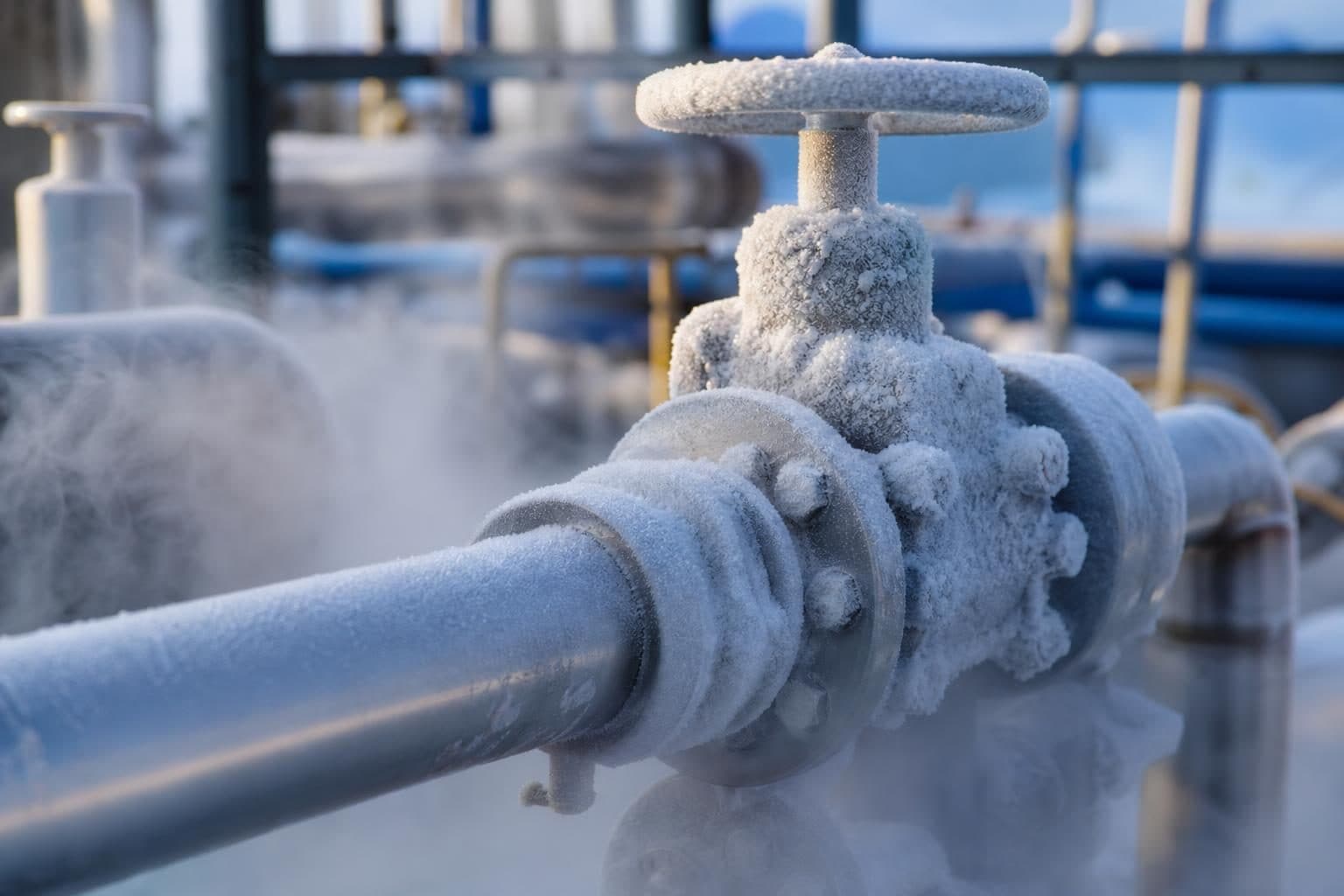
LNG cryogenic tanks
A liquefied natural gas tank solves the density problem by cooling methane to around −162 °C, where it becomes a liquid of about 420 kg per cubic meter, a little over twice the density of CNG at 250 bar. The AFDC puts one gasoline gallon equivalent at about 1.5 gallons of LNG.
The engineering problem changes from pressure to heat. An LNG vehicle tank is a double-walled vessel, an inner stainless steel tank suspended inside an outer shell, with a vacuum between them and multilayer insulation wrapped around the inner vessel. Pressure is modest by CNG standards; vehicle LNG is commonly stored at up to about 200 psig (14 bar).
No insulation is perfect. Heat leaks in through supports, piping and the vacuum space, some liquid boils, and the vapor raises the pressure. While the truck is running, the engine draws that vapor off. When it sits parked, pressure climbs until the relief valve opens and vents a little gas. The time from a fresh fill to the first venting is the hold time, defined in ISO 12991 as the time for pressure to rise from its starting value to the inner tank's maximum allowable working pressure, and it is a direct measure of insulation quality. Hold time, boil-off and the cost of a cryogenic supply chain are the main reasons LNG suits trucks that run every day on predictable routes, a comparison laid out in CNG vs LNG.
Adsorbed natural gas tanks
A third route stores gas at room temperature and a modest pressure of about 35–50 bar by filling the tank with a porous adsorbent, usually activated carbon or a metal-organic framework. The adsorbent multiplies what the tank can hold at low pressure about fivefold, and the lower pressure allows lighter walls and non-cylindrical shapes. The penalties are lower capacity than CNG at 250 bar, heat released during filling, and gas that stays trapped on the adsorbent at low pressure. The full story is in the guide to adsorbed natural gas.
Stationary storage: cascades, bulk and underground
Station storage and cascades
A fast-fill CNG station does not compress gas straight into the vehicle. It compresses into stationary storage vessels, often at a service pressure of about 4,300 psi, so the dispenser can fill a car or truck in minutes. Storage is commonly split into banks at different pressures, called a cascade. The dispenser draws from the low bank first, then the middle, then the high bank, so the highest-pressure gas is saved for topping off and the compressor has less work to do between vehicles. Station storage is one of the few places where heavy Type I steel cylinders and long steel tubes still make the most sense, because they never move.
A time-fill station, typical for fleets that refuel overnight, works differently. Vehicles connect to a manifold and fill directly from the compressor over several hours, with only a small buffer tank in the system. The gas heats less during a slow fill, so each tank ends up fuller.
Bulk transport
Gas that has to reach a site off the pipeline network travels in tube trailers, banks of large cylinders on a truck chassis, or in modules of composite cylinders that can be swapped between a filling point and a customer. These are mobile natural gas storage tanks in the most literal sense, and the virtual pipelines page covers how such delivery chains are planned.
Underground storage
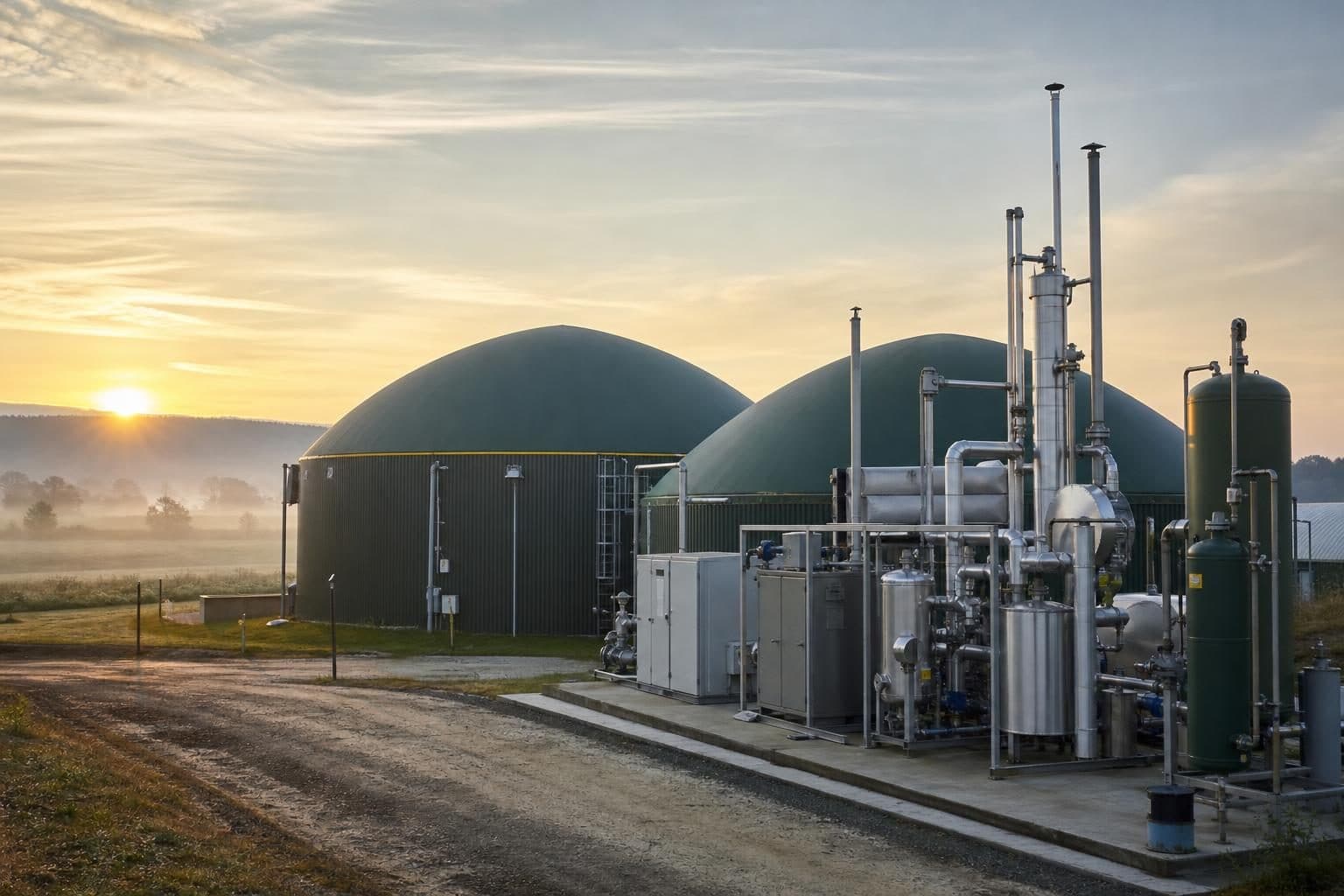
Seasonal storage for whole regions does not use tanks at all. Utilities and pipeline operators inject gas into depleted oil and gas reservoirs, aquifers capped by impermeable rock, and caverns leached out of salt formations, then withdraw it in winter. According to the US Energy Information Administration, about 120 operators run nearly 400 active underground storage facilities in the Lower 48 states. Depleted reservoirs are the most common type; salt caverns give the highest injection and withdrawal rates for their size. Many utilities also keep aboveground LNG tanks for the coldest days of the year.
Small, portable and home tanks
Portable natural gas tanks are rarer than most people expect, and the reason is physics. Propane and butane turn liquid at under 10 bar at room temperature, so a 9 kg barbecue bottle holds a lot of energy in a light, thin-walled steel can. Methane stays a gas at any pressure above about −82.6 °C, so the only way to carry it in a small container is at full CNG pressure. A portable cylinder charged to 200 bar needs the same thick walls, valve and certification as a vehicle tank, and holds only a few kilograms of gas. Small CNG cylinders do exist for forklifts, generators and some industrial tools, but there is no natural gas equivalent of the camping cartridge.
Homes on the grid have no reason to store natural gas at all. The distribution main delivers it at low pressure, the meter measures it, and the supply is continuous. Questions about how to store natural gas at home safely usually come from two situations. The first is a home vehicle refueling appliance, a small wall-mounted compressor that fills a car's own tank slowly overnight, with no storage of its own. The second is a remote property off the gas network, which almost always ends up with a propane tank or, at larger scale, a small LNG installation under a supply contract. Storing compressed natural gas in loose cylinders in a garage is not a normal practice and in most places breaks the fire code.
Reading a CNG cylinder label
Every certified vehicle cylinder carries a label, and it answers most questions faster than paperwork can. It names the standard the tank was built to, for example NGV 2 or ISO 11439, the manufacturer and serial number, the service pressure, the date of manufacture and the "DO NOT USE AFTER" date. US labels also carry the inspection reminder required by FMVSS 304. A missing or unreadable label is itself a reason to take the cylinder out of service, because without it an inspector cannot confirm what the tank is rated for. Fleet managers usually log these details for every tank when the vehicle arrives, which turns the expiry date into a scheduled replacement and not a roadside surprise.
Safety features and failure modes
Three hazards shape the safety hardware on CNG storage tanks: fire, physical damage and overpressure.
Fire is handled by the pressure relief device (PRD), usually mounted at the cylinder valve and triggered by temperature. In a vehicle fire, the PRD opens and empties the tank through a vent line before heat can weaken the cylinder wall. A composite tank exposed to fire without a working PRD can rupture, so vent lines must be capped against water and debris and inspected along with the tank. Long cylinders on buses often carry PRDs at both ends, because a fire at one end of a 3-meter tank may not heat a single device at the other.
Physical damage is handled by design margins and inspection. The minimum burst pressure is several times the working pressure, and qualification tests include drop, impact and cut-flaw tolerance. Excess-flow valves and manual shutoff valves limit how fast gas can escape if a line is broken.
Overpressure is mostly handled at the station. Dispensers measure pressure and temperature and stop at the right settled fill, and nozzle and receptacle designs prevent connecting a vehicle rated for a lower pressure to a higher-pressure dispenser.
Natural gas itself adds one more safety feature. It is lighter than air, so a leak outdoors rises and disperses, and the guide to whether natural gas is clean explains why that sets it apart from propane, which sinks. Indoors, garages and maintenance shops are ventilated at ceiling height and fitted with methane detectors for the same reason.
Choosing among natural gas storage tanks
For a fleet, the decision usually starts from the duty cycle. Roof-mounted Type IV tanks suit buses and refuse trucks that refuel nightly at a depot. Type I steel can make sense for a light commercial vehicle that runs short urban routes and returns to base, where the weight costs little and the price saving is immediate. Long-haul trucks with high daily fuel use tilt toward LNG or high-capacity Type IV packs behind the cab. Natural gas storage tanks in every category are certified to a limited life, so the replacement cost belongs in the total cost of ownership from the start, alongside fuel and maintenance.