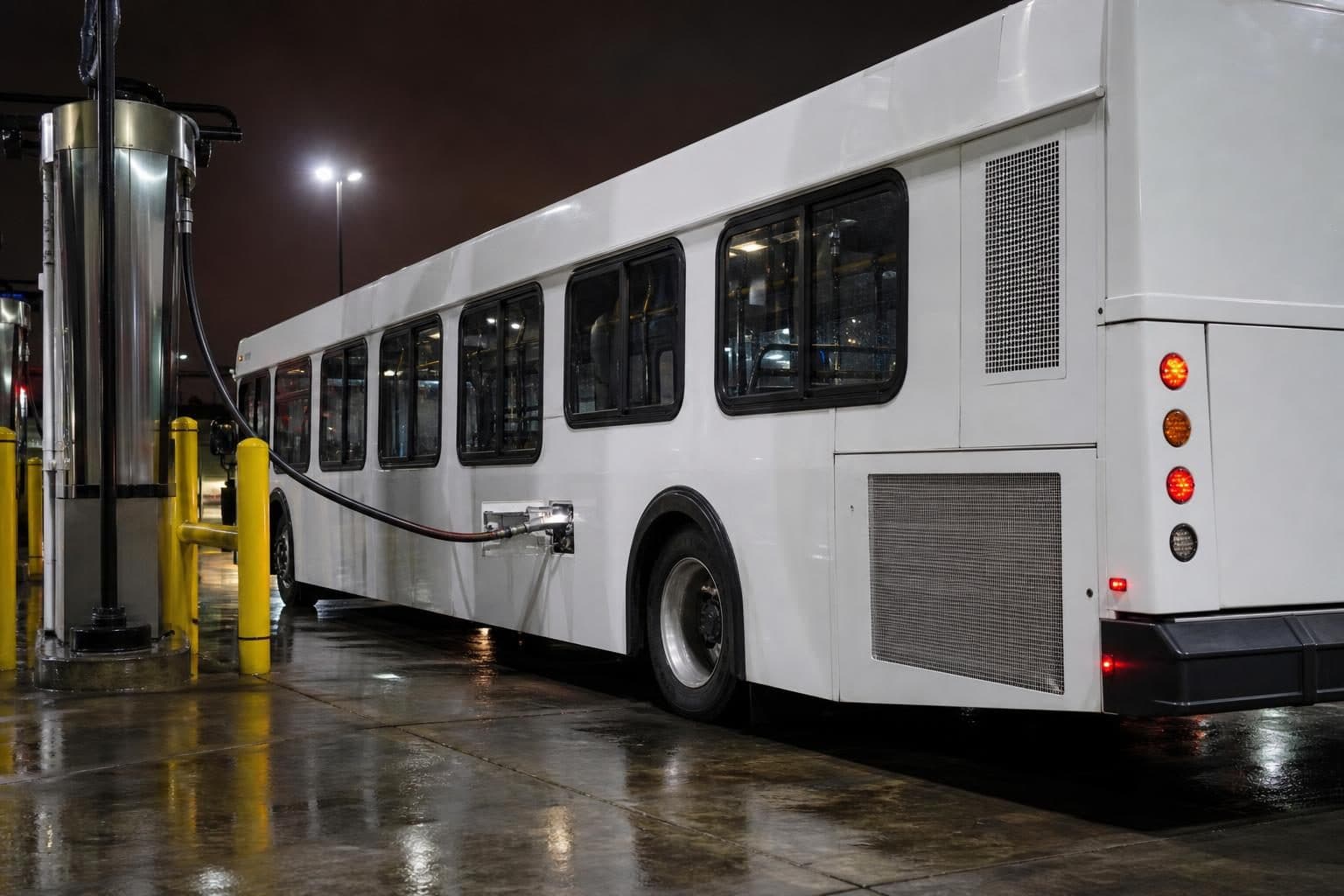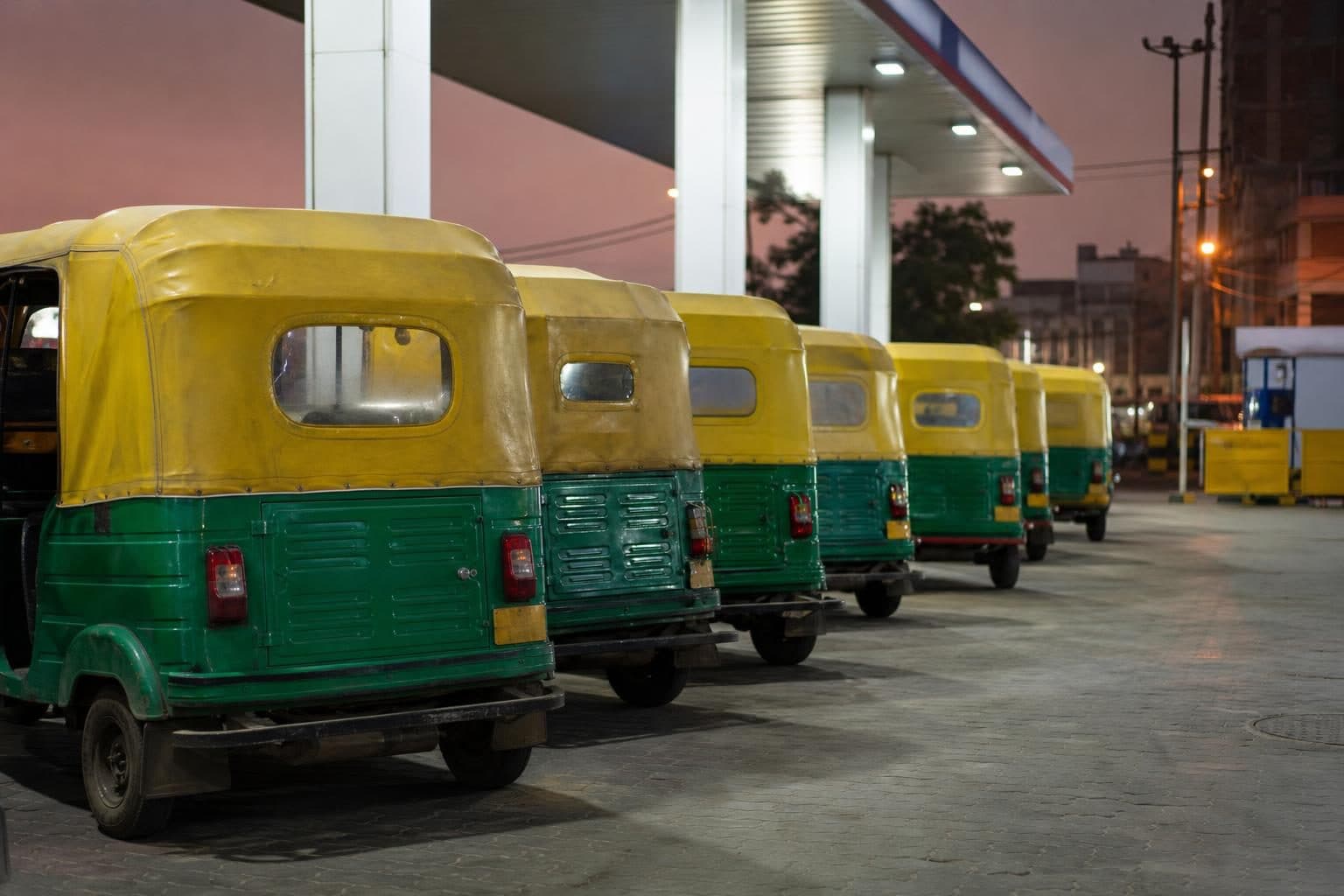
At 2 a.m. in a transit depot, forty buses sit in rows with a hose clipped to each one. Nobody is standing at a pump. A compressor in a sound-insulated enclosure at the edge of the yard has been running since the last bus came in, and it will keep going until the first driver arrives. That is a time-fill station, and it looks nothing like the public forecourt where a taxi pulls in, connects a nozzle and leaves four minutes later with a full cylinder.
Both are CNG fueling stations, built from the same five components. What differs is where the gas waits before it reaches the vehicle. The fuel itself, and the pressures vehicles are built for, are covered in the guide to what CNG is.
The parts every station shares
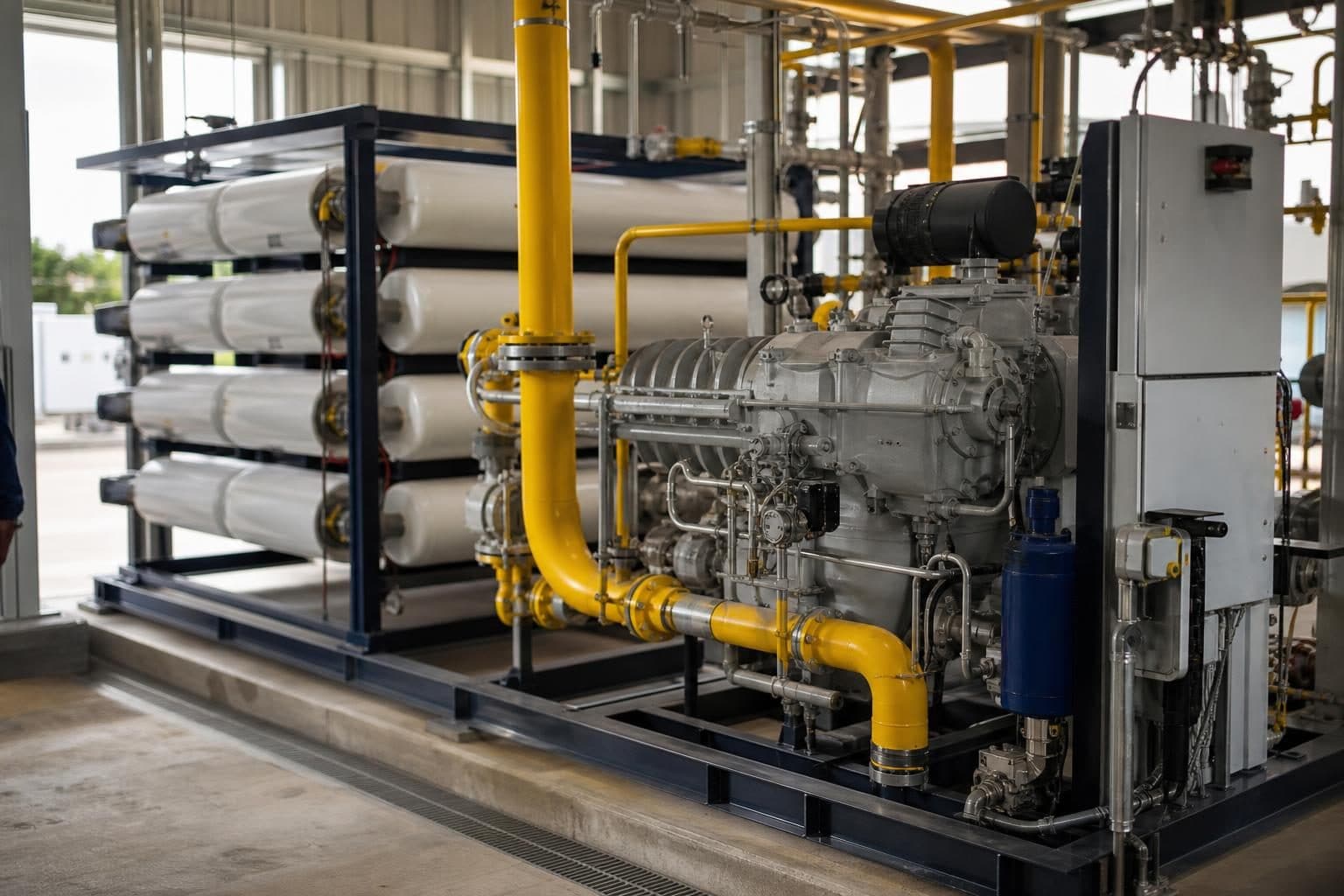
Gas arrives from a utility main at anything from a fraction of a bar to several tens of bar, depending on how close the station sits to a transmission line. It passes through a meter and a filter, then reaches the dryer, the compressor, storage or a buffer vessel, and finally the dispenser.
Compressor
The compressor raises gas from inlet pressure to about 250 bar for vehicles, or higher for storage. Station compressors are usually reciprocating machines with three or four stages and cooling between each stage, since every compression step heats the gas. Inlet pressure matters a great deal: lifting gas from 20 bar to 250 bar is far easier than starting from 1 bar, and a site near a high-pressure main can use a smaller machine and less electricity.
Dryer
Pipeline gas is dry enough for a kitchen stove and too wet for a 250-bar cylinder. Water vapor that stays in the gas can condense as pressure rises, freeze in the pressure regulator when the gas expands again inside the vehicle, or combine with traces of carbon dioxide and hydrogen sulfide into acid that attacks cylinder walls. Stations use desiccant towers, usually in pairs so one can regenerate while the other works. A dryer upstream of the compressor protects the machine too; a downstream dryer is smaller because it handles compressed gas.
Storage and the cascade
Fast-fill stations hold gas in high-pressure vessels, often at about 4,300 psi, roughly 296 bar. Because vehicle cylinders fill to 3,600 psi, about 248 bar, the pressure difference drives a quick transfer. Storage is usually split into three banks, low, medium and high. A priority panel draws first from the low bank until the flow slows, then switches upward. The arrangement lets the station use a larger share of its stored gas before the compressor has to start again.
Dispenser
The dispenser meters gas by mass, displays it in kilograms or gasoline gallon equivalents and stops the fill at a pressure corrected for temperature. On a cold morning it stops lower; on a hot day it overshoots slightly so the cylinder settles near its rating once the gas cools.
Fast-fill: built for random arrivals
A fast-fill station suits retail sales and mixed fleets where vehicles show up at unpredictable times. The compressor tops up storage between customers, and the storage absorbs short peaks. Sizing is a balance between compressor capacity and storage volume. If ten taxis arrive within fifteen minutes, the cascade carries the load; if they keep arriving all afternoon, the compressor has to match the average demand.
Speed has a cost in fill quality. Rapid filling produces more heat of compression inside the vehicle cylinder, so the gas is warm when the nozzle clicks off. A cylinder filled to 3,600 psi at an elevated gas temperature holds less mass than the same cylinder filled cool, and the pressure falls as it cools.
Time-fill: built for depots
Time-fill stations skip high-pressure storage almost entirely. Vehicles are connected to a manifold, and the compressor fills them all directly over several hours. A small buffer tank keeps the compressor from cycling on and off, and can top off a vehicle if needed, but it is not the main source of fuel.
The US Alternative Fuels Data Center gives a feel for sizing: a transit bus operator may need a compressor delivering 8 to 9 gasoline gallon equivalents per minute, a refuse fleet can work with about 3, and a single household appliance may deliver less than one gallon equivalent per hour.
A worked example shows what those rates mean overnight. A compressor delivering 3 GGE per minute for a ten-hour shift supplies 1,800 GGE, which is 1,800 × 2.567 kg ≈ 4,620 kg of gas. If each refuse truck needs about 40 GGE for its route, that one machine fills 45 trucks. If a depot refuels overnight and vehicles park for ten hours or more, time-fill is usually the cheaper option to build and run.
Combination stations do both: time-fill posts in the yard, with a fast-fill dispenser for vehicles that come back mid-shift or for outside customers. They cost more to build, and a public fast-fill lane can earn revenue that helps pay for it.
Codes: NFPA 52, ISO 16923 and the rest
In the United States, NFPA 52, the Vehicular Natural Gas Fuel Systems Code, governs CNG and LNG fuel systems on vehicles and the stations that fill them, including separation distances, venting, emergency shutdown and electrical classification near dispensers. Local fire codes adopt it by reference. Internationally, ISO 16923 covers CNG stations, and national codes in Italy, India, Argentina and elsewhere add their own approval processes. Vehicle-side connections follow standardized receptacles, such as CSA/ANSI NGV 1 nozzles in North America, so that any certified vehicle can fill at any compliant dispenser.
Small stations and home refueling appliances
Below the depot scale sit compact units for a handful of vehicles: skid-mounted compressors delivering a few GGE per hour, installed at a workshop or a small fleet yard. Below those again are residential fueling appliances, small enough to hang on a garage wall. In North America they are certified to CSA/ANSI NGV 5.1, and NFPA 52 contains a dedicated chapter on their installation. They draw gas from the household supply and fill a single car overnight.
Slow filling is the point of these units. A machine that moves less than a gallon equivalent per hour is cheap to build and quiet enough for a garage, and the overnight fill avoids the heat-of-compression shortfall of a fast pump.
Another route to cheaper small stations is lower pressure. If a vehicle's tank works at 35–60 bar, the station needs far less compression, and the hardware becomes simpler. At 60 bar and 15 °C, though, methane weighs only about 45 kg/m³ against 199 kg/m³ at 250 bar, so a low-pressure tank needs an adsorbent inside it to hold a useful amount. That approach is explained on the page about adsorbed natural gas, and it was tried in particular for scooters and three-wheelers.
What makes a station pay
Station economics come down to utilization. Compressors, dryers, storage and dispensers are a fixed cost whether the station sells 100 kg a day or 10,000 kg, so the cost per kilogram falls steeply as throughput rises. A captive fleet that refuels every night gives the operator predictable demand. Many public CNG networks grew outward from bus and refuse depots for exactly that reason, opening a public lane once the depot load covered the fixed costs.
Running costs are dominated by electricity for compression and by maintenance, since reciprocating compressors need regular valve and seal work. Demand charges on the power bill can be large if a big compressor starts at peak hours; time-fill depots often schedule compression at night partly for this reason. Inlet gas pressure, as noted above, changes the energy needed per kilogram, and sites are sometimes chosen for their distance to a high-pressure main.
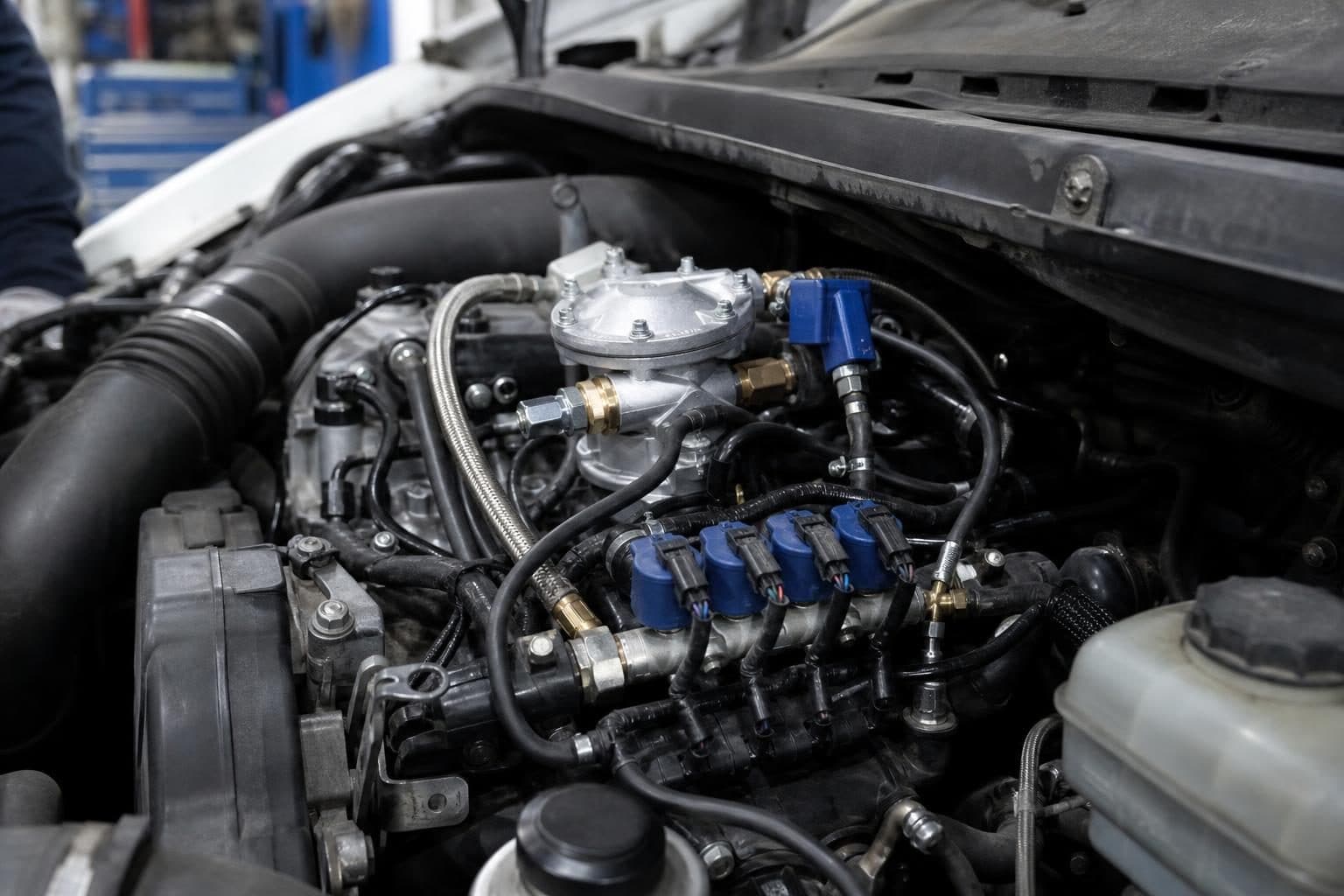
For a fleet choosing a fuel, the station is often a bigger decision than the vehicles. The vehicles themselves can be bought new or converted, and the kit that converts a gasoline vehicle is described on the page about NGV conversion. Where no pipeline reaches the site at all, gas can be delivered by truck, a model covered under virtual pipelines.