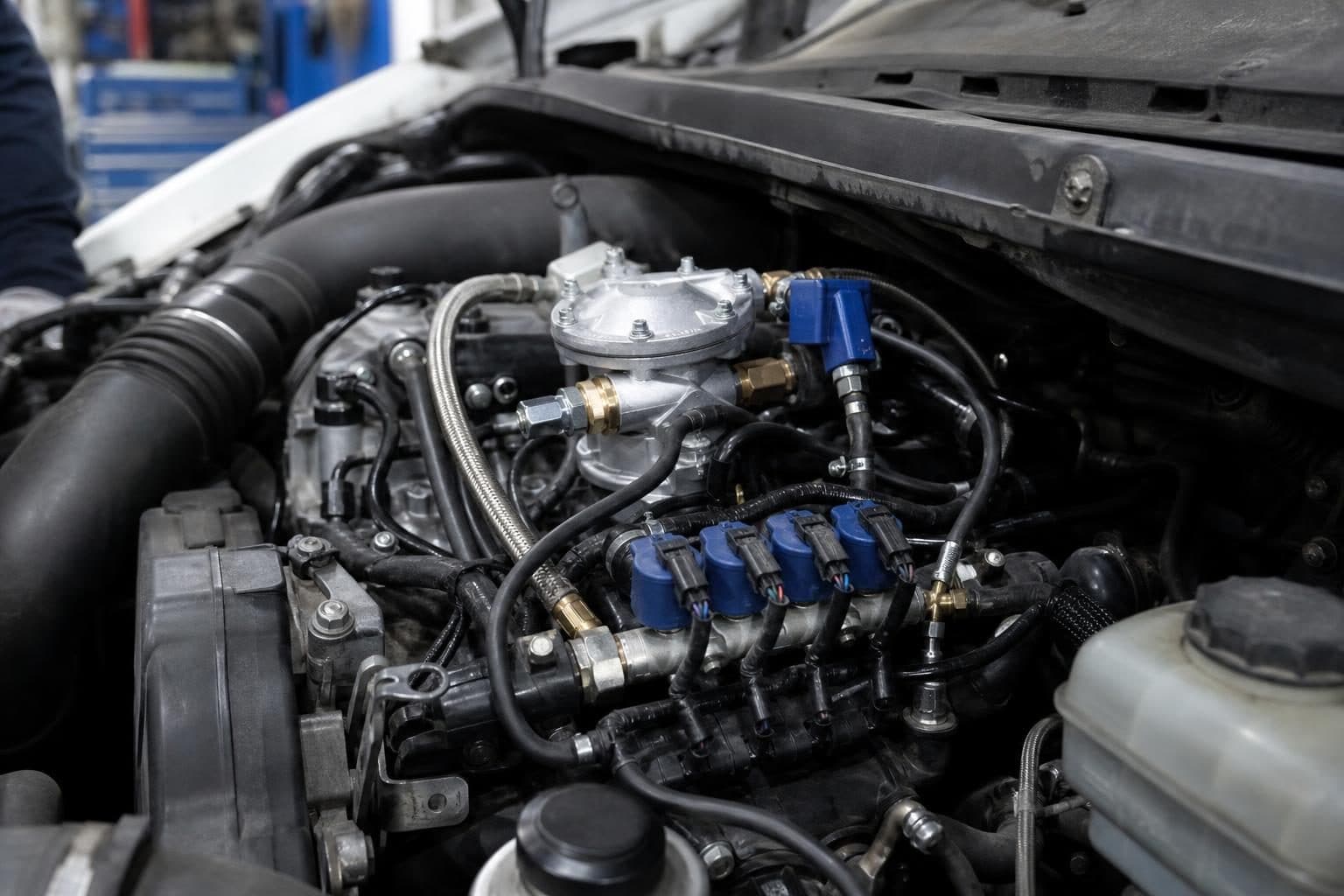
Open the trunk of a converted sedan in Bogotá or Tehran and the first thing visible is a steel cylinder the size of a scuba tank, strapped to the floor where the spare wheel used to be. Everything else in the conversion is smaller and easier to miss: a regulator bolted near the engine, a row of injectors on the intake manifold, a second control unit tucked behind a panel, and a switch on the dashboard.
That proportion holds for most conversions. The engine changes very little; the storage and the approval process take up most of the effort.
What goes into a conversion kit
A modern kit for a gasoline engine with port injection is built around the storage end. One or more CNG cylinders go in the trunk, under the floor or on the roof, each with a manual shut-off, a solenoid valve that closes automatically when the engine stops, and a pressure relief device that vents the gas if a fire heats the tank. Gas enters through a standardized fill receptacle, such as an NGV 1 receptacle in North America, with a check valve so it cannot flow back out. Stainless steel tubing carries it forward, routed away from exhaust heat and shielded from road debris.
At the engine, the pressure regulator does the heavy work. It drops gas from storage pressure, up to about 250 bar, to a working pressure of a few bar. Expansion cools the gas sharply, so the regulator is warmed by engine coolant to stop it icing. From there the gas feeds a rail of electronically controlled injectors, one per cylinder, that meter it into the intake ports.
The last part is a second control unit. The gas ECU reads the original engine computer's gasoline injection signals and translates them into gas injection times, using maps set up during calibration. A fuel selector and a gauge on the dashboard complete the installation, and the original engine computer keeps running the ignition, the lambda control and the diagnostics.
A cold start is often done on gasoline in bi-fuel systems, with the switch to gas once the regulator reaches temperature. Older systems used a mixer, a venturi in the air intake, and sometimes still appear on carbureted engines and small industrial units.
Bi-fuel, dedicated and dual-fuel
A bi-fuel conversion keeps the gasoline system working and adds gas alongside it. The driver keeps full range on gasoline, which helps where stations are sparse, and the gas tank can be smaller. In Latin America almost nine in ten natural gas vehicles are bi-fuel, which reflects how common aftermarket conversion has been there.
A dedicated conversion removes reliance on gasoline. The engine can then be calibrated, and sometimes rebuilt with higher compression, to suit methane's knock resistance. Dedicated vehicles are more common among factory-built heavy vehicles than among conversions.
Dual-fuel systems are a diesel arrangement. Gas is admitted with the intake air, and a reduced diesel injection ignites the mixture. The share of gas varies with load and with the system; at idle many dual-fuel engines run on diesel alone. A heavy diesel can also be converted to spark ignition, which needs new pistons for a lower compression ratio, spark plugs and an ignition system.
The fuel being burned, and why methane needs a spark or a pilot to ignite, is explained in the guide to what CNG is.
US EPA rules for conversions
Under the Clean Air Act, removing or disabling a vehicle's emissions controls is tampering, and tampering carries a significant fine. Installing a gas system changes how the engine is fueled, so a conversion needs an exemption from the tampering prohibition. The rules in 40 CFR Part 85 provide one, as long as the conversion system meets the requirements for the vehicle's age. The US Alternative Fuels Data Center describes three categories.
| Vehicle age | What the kit maker must show | Paperwork |
|---|---|---|
| New and relatively new (no more than one year after the model year) | Emissions test data for the specific engine family | EPA or CARB Certificate of Conformity |
| Intermediate age, within the useful life | The conversion meets the emissions standards of the year the vehicle was built | EPA lists compliant systems; no certificate issued |
| Outside the full useful life | The system is technically sound | EPA lists compliant systems; no certificate issued |
Kits approved only for older vehicles cannot legally be fitted to new or intermediate-age vehicles. In California, CARB approval is required separately, and EPA documents do not replace it. Emissions standards are fuel-neutral, so a converted vehicle has to meet the same limits as it did on gasoline or diesel. EPA's current tampering enforcement policy dates from 2020.
If a fleet manager is buying kits, the practical test is simple: the kit must be listed for that exact engine family and model year, and the installer should be a technician associated with the kit manufacturer that holds the certificate or exemption.
Europe handles the same problem differently. UN ECE Regulation 110 sets requirements for the gas components themselves, and Regulation 115 covers retrofit systems for vehicles already in service, with type approval of the kit for each vehicle family.
Payback: a worked example
Conversion pays through fuel savings, so the arithmetic starts with distance. Take a delivery van that covers 40,000 km a year and uses 10 liters of gasoline per 100 km. It burns 4,000 liters a year, about 1,057 US gallons.
Now assume, purely for illustration, that gas costs one dollar less per gasoline gallon equivalent than gasoline and that the van's efficiency on gas is the same. The yearly saving is about $1,057. A conversion that costs ten times that pays back in about ten years, which is longer than many vans stay in service. Double the distance or the price gap and payback halves.
Four things move the result more than the kit price: annual distance, the local fuel price gap, access to a station near the route, and any loss of payload or cargo space from the cylinders. A taxi running two shifts a day is the classic case where conversion works. A private car covering 10,000 km a year usually is not, unless the price gap is very large, as it has been in countries with subsidized gas.
Heavy vehicles and repowers
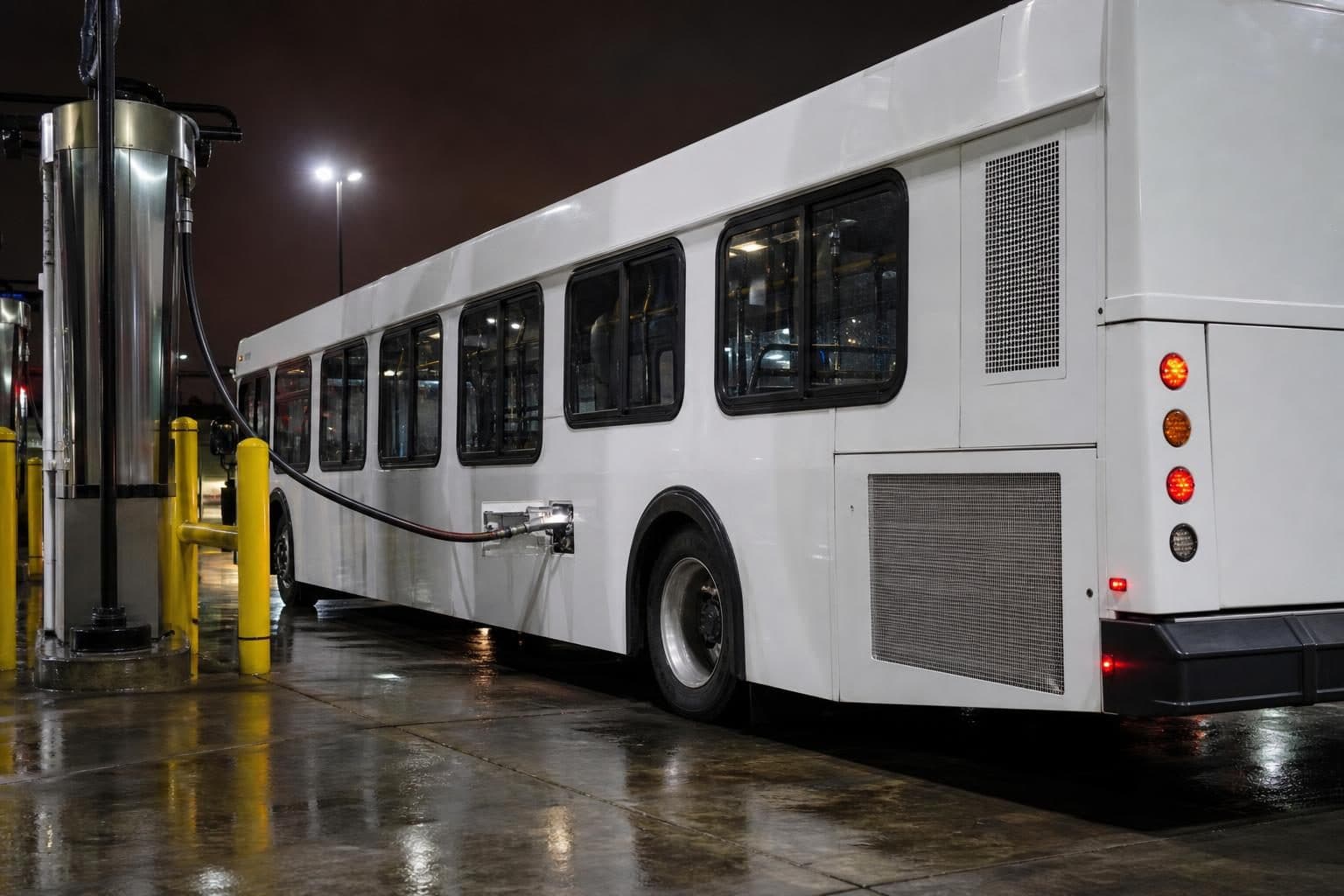
For trucks and buses the economics and the engineering both change. Heavy engines burn far more fuel, so savings accumulate faster, but the cylinder package for a day's work weighs hundreds of kilograms and has to fit on frame rails or a roof. Many fleets skip conversion entirely and repower: the original diesel comes out and a factory-built natural gas engine goes in, with its own certification. A repower costs more than a kit but avoids the calibration compromises of a converted diesel, and the certified engine brings its emissions paperwork with it.
Safety inspections after the conversion
Cylinders are the part that needs ongoing attention. US guidance calls for an inspection of light-duty vehicle cylinders every 36 months or 36,000 miles, whichever comes first, every 12 months on vehicles above 10,000 lb gross weight, and after any fire, crash or other incident that might have damaged a tank. Inspectors look for cuts, abrasion and chemical damage on composite wraps, check the mounting brackets and confirm the label and expiry date.
CNG cylinders have a service life of 15 to 20 years depending on construction and certification. They cannot be requalified for longer use and have to be replaced on expiry, which matters on a used converted vehicle: a ten-year-old car with a cylinder near the end of its life carries a replacement cost the buyer may not expect.
Leak checks on the high-pressure line and the regulator belong in routine servicing. Methane is lighter than air and disperses upward, so workshops that service gas vehicles need ventilation at ceiling level, and US repair-garage codes set requirements for it.
Emissions after conversion
A well-calibrated conversion of a gasoline engine produces very low particulate emissions and lower CO2 per unit of fuel energy, since natural gas carries less carbon than gasoline. Results for NOx and hydrocarbons depend heavily on calibration and on keeping the original catalytic converter working; methane is hard for a standard three-way catalyst to oxidize when the exhaust is cool. Poorly fitted kits, common in some markets in the early years of mass conversion, can raise emissions. The EPA requirements above exist for that reason.
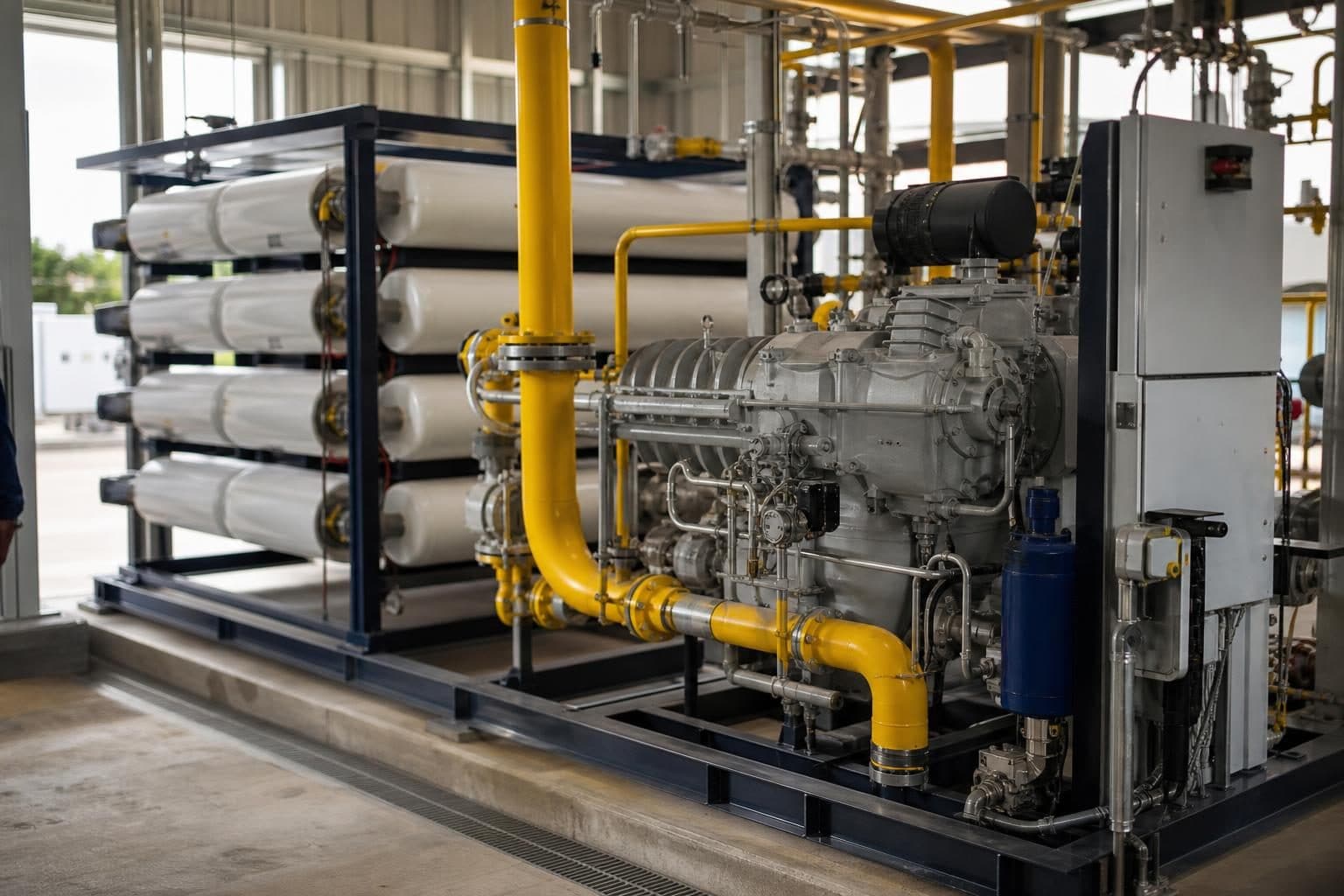
For two-stroke scooters and three-wheelers, where emissions gains from conversion were largest, the story is different and is told in the guide to two- and three-wheelers. Where a depot first needs a compressor before any vehicle can be converted, the options are set out under CNG fueling stations, and the general case for gas in transport is on the page asking why natural gas.