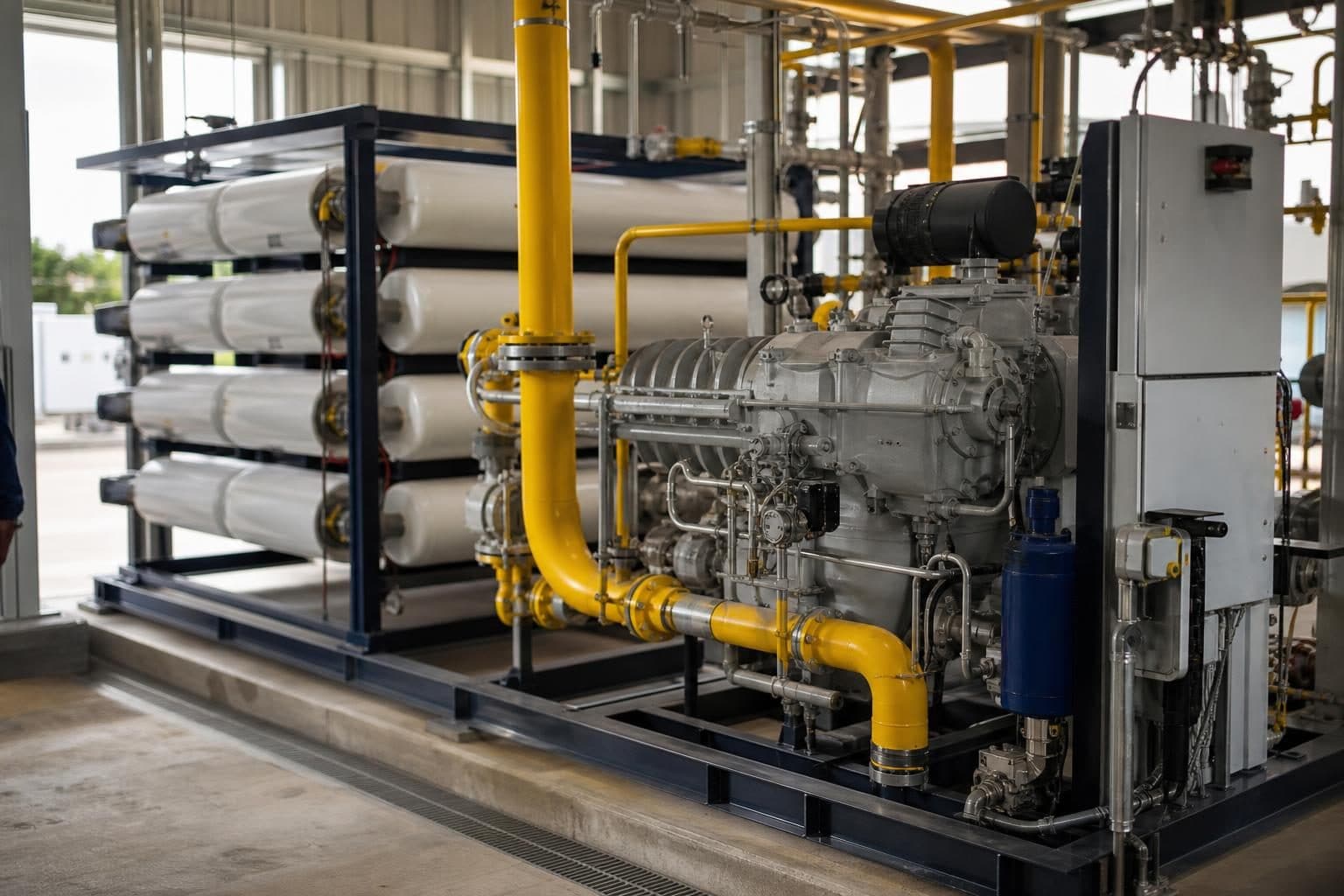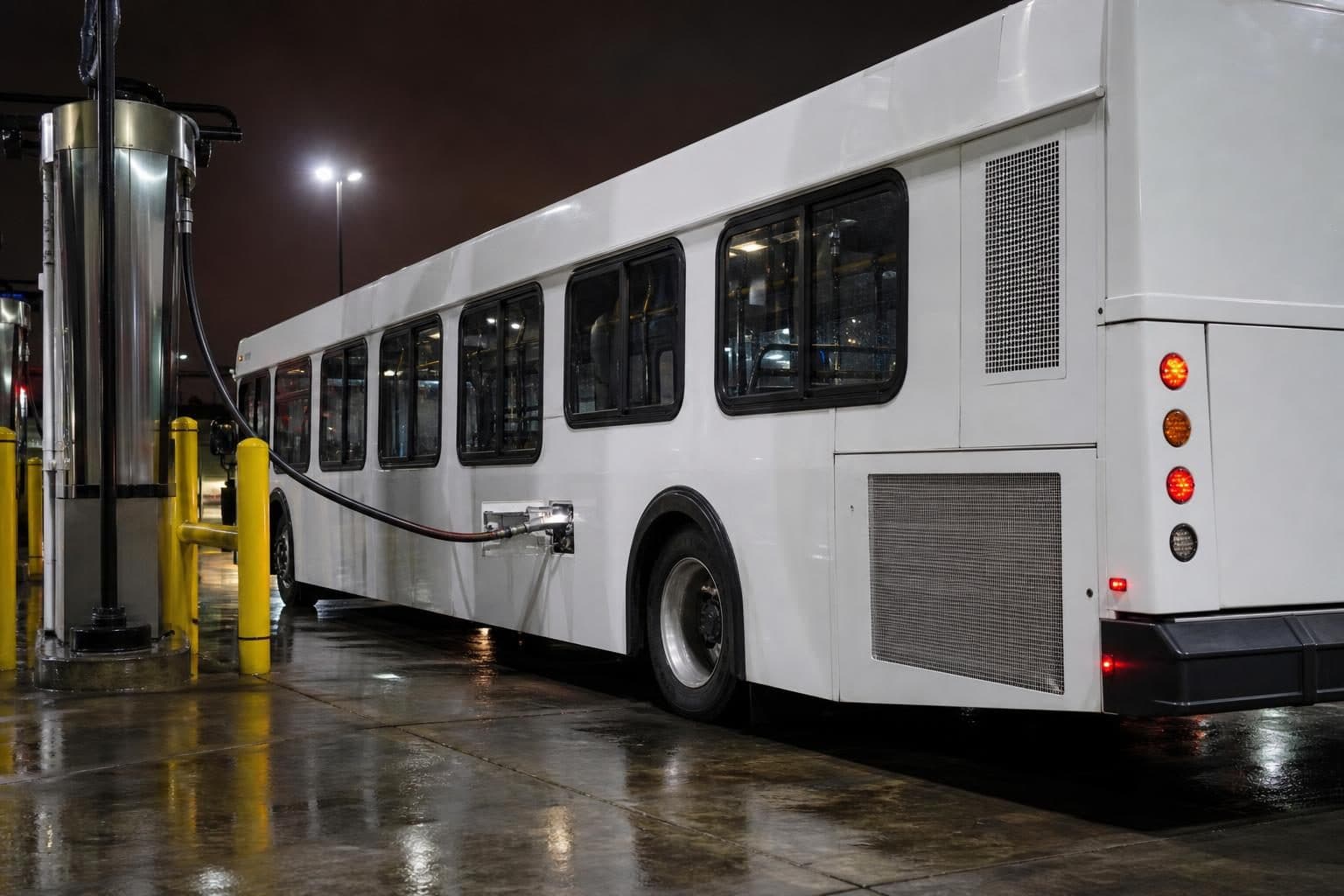
Look at the roof of almost any modern city bus with a raised fairing above the passenger area and there is a good chance it hides a rack of eight or ten long cylinders, each filled with methane at around 250 bar. That pressure is about 250 times what the atmosphere presses on the outside of the bus. The plain answer to what is CNG sits in that rack: natural gas, squeezed until enough of it fits on board to run a working day.
The idea is old. Italy had cars running on compressed methane before the Second World War, and the fuel spread wherever gas was cheap and gasoline was expensive or imported. What changed over the decades is the hardware around it: lighter cylinders, electronic injection, and dispensers that compensate for temperature.
What is CNG made of: inside the cylinder
Pipeline gas is predominantly methane, CH4, with smaller amounts of ethane, propane, nitrogen and carbon dioxide depending on the field it came from. Before it goes into a vehicle it has to be dry, because water left in the gas can freeze in regulators or form corrosive condensate inside a cylinder at high pressure. Fuel quality for vehicles is covered by ISO 15403, and in the United States by SAE J1616.
At normal atmospheric pressure and 15 °C, methane weighs about 0.68 kg per cubic meter. NIST reference data put it at 167.75 kg/m³ at 200 bar and 199.25 kg/m³ at 250 bar, at the same temperature. So a fill to 250 bar packs roughly 290 times as much gas into a given volume as the open air holds. The gas never liquefies at these conditions; at 15 °C methane is far above its critical temperature and simply keeps getting denser as pressure rises.
A worked example makes the numbers concrete. An 80-liter cylinder, a common size for a car, holds 0.080 m³ × 167.75 kg/m³ ≈ 13.4 kg of methane at 200 bar and 15 °C. Divided by 2.567 kg per gasoline gallon equivalent, that is about 5.2 GGE, the energy of a little under 20 liters of gasoline. Raise the fill to 250 bar and the same cylinder carries about 15.9 kg. You can run other sizes and pressures through the tank capacity calculator.
The cylinders themselves come in four families. Type I is all steel. Type II is a steel liner with a hoop wrap of glass or carbon fiber. Type III uses a thin aluminum liner fully wrapped in composite, and Type IV has a plastic liner with the composite carrying all the load. Weight falls from Type I to Type IV while cost per liter rises, and the choice is examined in more detail in the guide to natural gas storage tanks. Design and test rules come from ISO 11439 internationally, UN ECE Regulation 110 for vehicles approved in Europe and many other markets, and FMVSS 304 plus CSA/ANSI NGV 2 in the United States.
Fuel units explained: GGE, DGE and kilograms
Gas sold by the cubic meter or cubic foot means little to a driver comparing prices with a gasoline pump, so retail units were invented to bridge the gap. The US Alternative Fuels Data Center uses 5.66 lb of CNG, about 2.567 kg, as one gasoline gallon equivalent. For liquefied natural gas the reference unit is the diesel gallon equivalent, set at 6.06 lb, about 2.75 kg, of LNG.
Outside North America most stations simply sell CNG by the kilogram, which is the honest unit for a fuel whose volume depends on pressure and temperature. Since 2.567 kg replaces 3.785 liters of gasoline, one kilogram of CNG carries the energy of about 1.47 liters, and a price per kilogram has to be divided by that factor before it can sit beside a price per liter.
Temperature muddies every one of these units. Gas warms as it is pushed into a cylinder, so a tank filled quickly on a hot afternoon reads full at the nozzle and then loses pressure as it cools overnight. A driver who sees 200 bar at the dispenser may find 180 bar the next morning without a single gram having leaked. Modern dispensers estimate the gas temperature and stop at a higher pressure to offset the effect, but on a summer day a fast fill still delivers somewhat less mass than the gauge suggests.
Anyone asking what is CNG fuel at the pump worth in practice should compare cost per kilometer driven, using the vehicle's consumption in kg/100 km, because the energy units hide differences in engine efficiency.
Vehicles that run on it, and where
The fuel suits vehicles that return to the same depot every night and drive predictable distances. That is why compressed natural gas vehicles cluster in a few roles: city buses, refuse trucks, taxis, delivery vans and private cars in countries with dense station networks. The Delhi Transport Corporation runs one of the largest CNG bus fleets in public transport anywhere, and Delhi's auto-rickshaws moved to the fuel after court orders in the late 1990s, a story told on the page about two- and three-wheelers.
Country totals swing with fuel prices and subsidy policy, so any count needs a year beside it. Figures compiled for 2017 put the world fleet at about 24.5 million natural gas vehicles, led by China with about 5 million, Iran with about 4 million, India and Pakistan with about 3 million each, Argentina with about 2.3 million, Brazil with about 1.8 million and Italy with about 1 million. Later estimates put the global figure near 28 million by 2019.
The United States is a different case. Its fleet was put at about 160,000 natural gas vehicles in 2016, small by comparison, but they are concentrated in heavy, high-mileage fleets: transit agencies, refuse haulers and regional trucking, many of them fueled at private depots.
How compressed natural gas vehicles burn the gas
Almost all light compressed natural gas vehicles use spark ignition, the same Otto-cycle principle as a gasoline engine. Methane has a high octane rating and resists knock, so dedicated engines can run higher compression ratios than gasoline versions, and the gas mixes completely with air before combustion. Cold starts are easy because there is no liquid film to evaporate on cold cylinder walls.
Three layouts exist. A dedicated vehicle runs only on natural gas. A bi-fuel vehicle carries two separate fuel systems and switches between gasoline and gas, which is common in Latin America, where almost nine in ten natural gas vehicles are bi-fuel. Iran's fleet leans toward dedicated engines with gasoline kept as a backup. Dual-fuel engines, traditionally a heavy-duty arrangement, burn gas but rely on a small injection of diesel to ignite it, since methane does not ignite reliably from compression alone.
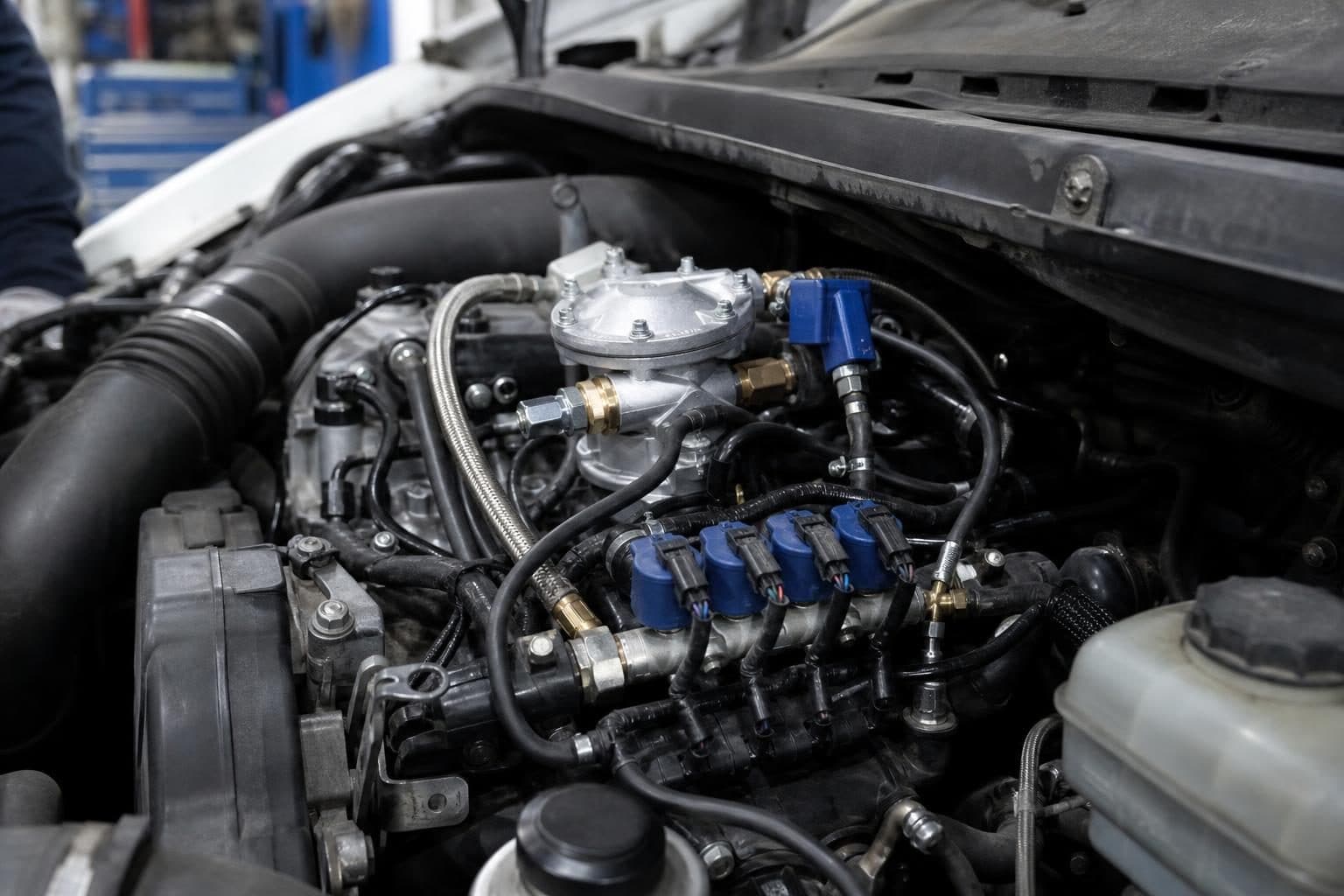
For a gasoline car, the kit that makes this happen is covered on the page about converting vehicles to natural gas. A converted bi-fuel engine is calibrated for gasoline first and gas second, which costs a little efficiency compared with a factory-dedicated design.
Range: the cost of storing a gas
Range is the practical limit. One gasoline gallon equivalent is 2.567 kg of CNG; at 250 bar and 15 °C that mass occupies about 12.9 liters, against 3.79 liters for the gallon of gasoline it replaces. A CNG cylinder therefore needs roughly three and a half times the internal volume for the same energy, before counting the thickness of its walls. Fleets either accept shorter range or give up cargo space and payload for more cylinders. Most of that gap is explained by density, not by the engine.
Heavy trucks that need long range often move to LNG, which carries the same molecules at about 422 kg/m³ as a cryogenic liquid. The trade-offs between the two are laid out in CNG vs LNG, and a third route, holding gas at lower pressure inside a porous solid, is described on the adsorbed natural gas page.
Emissions and safety in service
Natural gas carries less carbon per unit of energy than oil products. EIA coefficients give 52.91 kg of CO2 per million Btu for natural gas, 70.66 kg for finished motor gasoline and 74.14 kg for diesel, so combustion CO2 per unit of energy is roughly 25–30 percent lower. The per-kilometer figure is smaller because a spark-ignited gas engine is usually less efficient than a diesel, and any methane that escapes unburned is a strong greenhouse gas. Particulate emissions from gas engines are very low, and stoichiometric engines with three-way catalysts reach low NOx levels. Part of the advantage is explained by chemistry: methane carries four hydrogen atoms for every carbon atom, more than any liquid fuel.
Cylinders are inspected on a schedule. US guidance calls for an inspection of light-duty vehicle tanks every 36 months or 36,000 miles, whichever comes first, and every 12 months for vehicles above 10,000 lb gross weight, as well as after any fire or crash. Each tank carries an expiry date, typically 15 to 20 years from manufacture, and is replaced when it arrives.
Anyone still asking what is CNG going to demand from a fleet should start with the depot: whether gas comes from a grid connection strong enough to feed a compressor, and how long vehicles sit overnight. That decision is the subject of the next page, on CNG fueling stations.